
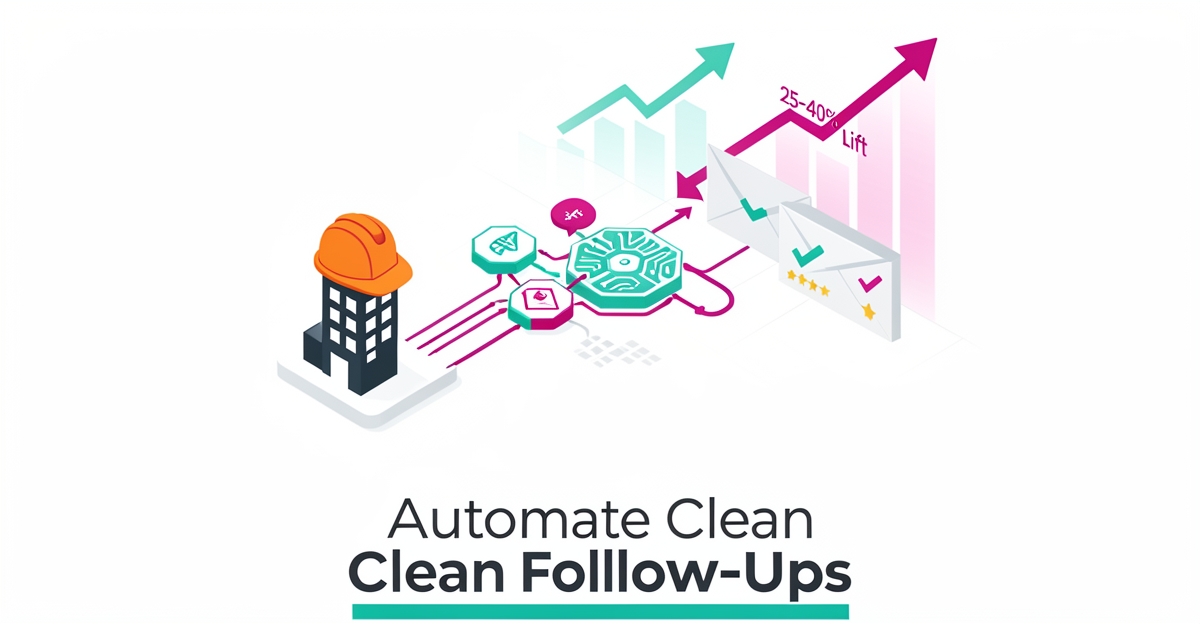
Key facts
- AI personalization in post-construction follow-ups boosts reply rates by 25-40% according to Overloop's testing.
- Warmed mailboxes achieve 94% inbox placement, outperforming unwarmed ones by 33% as per Overloop.
- Multichannel sequences (email + SMS/Call) yield 12-18% reply rates, outperforming email-only by 9% Overloop reports.
- Prospect-level AI personalization outperforms template-level AI by 2-3x in Overloop's benchmarks.
- AI reply classification automates review requests and escalations, streamlining post-construction follow-ups as seen with Reply.io's Jason AI.
- Hidden costs in AI email tools can inflate pricing 3-4x above advertised rates warns Overloop.
- Global average inbox placement for emails is 84%, with 1 in 6 legitimate emails missing the inbox according to Overloop.
WANT RESULTS LIKE THIS?
Imagine a system doing all of this for your local business — every day, without you.
We build local businesses a custom website with a team of AI behind it: every lead captured and followed up, new content published monthly,customers finding you on Google — live in 7 days.
- 85+ pages at launch
- Every lead followed up, automatically
- Your whole business on one screen
Why Most Post-Construction Follow-Ups Fall Through the Cracks
After a job is completed, most cleaning companies lose touch. This silent revenue leak happens not because of lack of effort, but because generic follow-ups fail to resonate. Research shows the average cold email reply rate is just 3.43%, and templated "thank you" messages perform even worse—often falling into the 3-5% range for email-only sequences. Without personalization, these emails feel transactional, not relational, and miss the chance to spark reviews or repeat business.
The problem isn't motivation—it's methodology. Most teams rely on manual outreach that gets delayed or forgotten, or they use one-size-fits-all templates that ignore job-specific details. Prospect-level AI personalization, which references specifics like property address or service date, outperforms template-level approaches by 2-3x with a 25-40% lift in reply rates. Yet without the right infrastructure, even well-crafted messages never reach the inbox. Warmed mailboxes achieve 94% inbox placement compared to 61% for unwarmed ones, making deliverability a foundational requirement, not an afterthought.
AI Business Sites addresses this gap by embedding intelligent follow-up directly into the website platform. Rather than bolting on separate tools, the system uses job data to trigger personalized email sequences within days of completion. These sequences can include multichannel touches—like an initial email, followed by an SMS reminder if unopened, and a phone task for the team if engagement stalls—mirroring strategies that yield 12-18% reply rates versus email-only approaches. By automating review requests for positive responses and escalating concerns to humans, the platform turns post-job silence into ongoing client connection.
What the Data Says About AI Email Sequences That Actually Work
The most effective post-construction follow-up sequences start with proven email automation principles. Data from Overloop’s testing of 1,000+ sequences shows that prospect-level personalization—referencing specific job details like property address or service date— delivers a 25-40% reply rate lift over generic templates. Industry research confirms this approach outperforms template-level AI by roughly 2-3x, making it essential for meaningful client engagement after a job.
Deliverability is equally critical. Warmed mailboxes achieve 94% inbox placement compared to just 61% for unwarmed ones, a gap that directly impacts whether your review request or service offer is even seen. Technical benchmarks emphasize that SPF, DKIM, and DMARC compliance are non-negotiable foundations; without them, even the most personalized sequence risks of the inbox.
For post-construction follow-up risks landing in spam.
Multichannel sequencing further amplifies results. Combining email with SMS reminders and phone call tasks yields 12-18% reply rates, versus only 3-5% for email-only efforts. Overloop’s findings show that integrated sequences— such as an initial email followed by an SMS if unopened, then a call task for engaged non-responders— create multiple touchpoints that respect client preferences while increasing response likelihood. For AI Business Sites, this means embedding these principles directly into the website’s follow-up engine so every completed job triggers a smart, sequenced outreach without manual setup.
Building a Post-Construction Follow-Up Sequence That Converts
Most cleaning companies finish a job and hope for the best. The data shows that hope isn't a strategy — AI-driven sequences that reference specific project details deliver a 25–40% lift in reply rates over generic templates, with prospect-level personalization outperforming simple merge tags by 2–3x according to Overloop's testing across 1,000+ sequences.
A four-step sequence grounded in those benchmarks starts with precision. Day 1 sends a personalized email that pulls the property address, service date, crew lead, and a direct Google review link — no "thank you for your business" filler. Day 3 targets non-openers with a short SMS nudge carrying the same review link, because multichannel sequences yield 12–18% reply rates versus 3–5% for email-only. Day 7 offers a seasonal maintenance package to engaged contacts who haven't reviewed yet, keeping the conversation useful instead of transactional. Day 14 creates a human call task for a satisfaction check, ensuring no signal falls through the cracks.
- Day 1 — AI-personalized email with job-specific recap and review link
- Day 3 — SMS nudge for non-openers with one-tap review access
- Day 7 — Seasonal maintenance offer for engaged non-reviewers
- Day 14 — Human call task for satisfaction verification
The system's real leverage appears when replies arrive. AI reply classification — the same autonomous handling Reply.io's Jason AI uses to classify responses and book meetings — routes positive sentiment ("great," "happy," "love the results") straight to a review request with a pre-filled link, while negative signals ("issue," "missed," "problem") escalate instantly to a human with full context. Neutral or silent contacts continue the nurture track automatically.
Deliverability makes it all work. Warmed mailboxes hit 94% inbox placement versus 61% unwarmed, so SPF, DKIM, and DMARC compliance isn't optional — it's the foundation AI Business Sites builds into every automated sequence from day one. The platform handles warming, authentication, and reputation monitoring as part of the website's operating layer, not as a separate tool you configure.
Local business: doing this the old way?
One system replaces the whole pile.
All of it — the website, the follow-up, the content, the leads — built and run for you for $1,497 + $497/mo. Month-to-month, and you own everything.
See what your build includesDeliverability Infrastructure: The Hidden Make-or-Break Layer
Most cleaning companies obsess over subject lines and send times, but the real battle happens before a single email leaves the outbox. Deliverability infrastructure — SPF, DKIM, DMARC, and a proper 2–4 week mailbox warmup — is the difference between landing in Primary and vanishing into spam.
Overloop's testing across 1,000+ sequences found that warmed mailboxes hit 94% inbox placement versus 61% for unwarmed. That 33-point gap isn't a rounding error — it's the difference between a follow-up sequence that generates reviews and repeat business, and one that nobody ever sees. Global average placement sits at 84%, meaning one in six legitimate emails already misses the inbox without authentication issues compounding the problem.
Standalone email tools treat deliverability as an afterthought — or worse, an upsell. The hidden cost model is brutal: credit overages and add-on modules can inflate actual pricing 3–4x above advertised starter rates. A cleaning business assembling a stack from separate providers ends up paying for warming services, reputation monitoring, and authentication tooling on top of the base subscription.
- SPF/DKIM/DMARC setup validated before first send
- Automated 2–4 week warmup built into the platform
- Ongoing reputation monitoring with automatic throttling
- No per-credit pricing — unlimited sends included
This is exactly why AI Business Sites bundles deliverability management into the core platform rather than bolting it on. The website handles the warmup, authentication checks, and reputation monitoring automatically — the same way it handles content generation and lead follow-ups. When a post-construction clean wraps up, the follow-up sequence fires from a mailbox that's already earned its reputation, not one gambling on day-one deliverability.
From One-Off Job to Recurring Revenue: The Compounding Effect
Most cleaning companies treat the final walkthrough as the finish line. In reality, it's the starting line for the next five jobs — if the follow-up runs on its own.
Research on AI email automation shows that prospect-level personalization delivers a 25–40% lift in reply rates over generic templates, with deep personalization outperforming simple merge tags by 2–3x. For post-construction follow-ups, that means every email references the actual job: the property address, the crew lead, the square footage, the before-and-after photos the client already saw. The system pulls this from the project record and writes the message — no one types a thing.
Deliverability is the silent killer of most sequences. Warmed mailboxes hit 94% inbox placement versus 61% for unwarmed ones, and SPF/DKIM/DMARC compliance is described as non-negotiable by practitioners running thousands of sequences. A follow-up that lands in spam generates zero reviews, zero referrals, and zero recurring revenue. The platform handles warming and authentication as part of the website setup — not an add-on the owner configures.
Multichannel sequences change the math entirely. Integrated email, SMS, and call-task workflows yield 12–18% reply rates compared to 3–5% for email alone. A post-construction sequence that works looks like this:
- Day 1: AI-personalized email with job recap + one-click Google review link
- Day 3: SMS nudge if the email wasn't opened
- Day 7: Seasonal maintenance offer drafted by AI, sent automatically
- Day 14: Phone call task created for the team if the client hasn't responded
AI reply classification closes the loop. When a client replies "crew was amazing," the system detects positive sentiment and fires the review request instantly. When they mention a missed spot, it escalates to a human with full context — no manual triage. This is how a single completed job becomes a review generator, a referral source, and a recurring service pipeline without the owner lifting a finger.
The consolidation matters. One system replaces the CRM, the automation builder, the email sender, the scheduling tool, the review platform, the project board, the document generator, and the newsletter software — eight subscriptions that don't talk to each other. AI Business Sites builds the website that already owns the client data, and the follow-up sequence activates inside it. The next step isn't buying another tool. It's turning on the sequence that's already connected to the jobs you just finished.
Frequently Asked Questions
Why do most post-construction follow-ups fail, and how can AI help?
What's the importance of deliverability in AI email sequences?
How effective are multichannel sequences over email-only approaches?
Can AI handle reply classification and automate next steps?
What's the typical structure of an effective post-construction follow-up sequence?
Why is it important to avoid separate tools for email automation and deliverability?
Key Takeaways
{ "title": "Turning Post-Construction Silence into Sustainable Growth", "content": "Automating client follow-ups after a post-construction clean with AI email sequences is not just about efficiency—it’s a strategic lever for sustainable growth. By leveraging prospect-level personalization, ensur
FOR local businesss — BUILT AND RUN BY US
Your website. Your content. Your leads. Your data.
$500 starts your build. Seven days later it's live — chat, booking, follow-up, and your Google presence all set up. Then we run it, every month. You do the work you actually get paid for.