
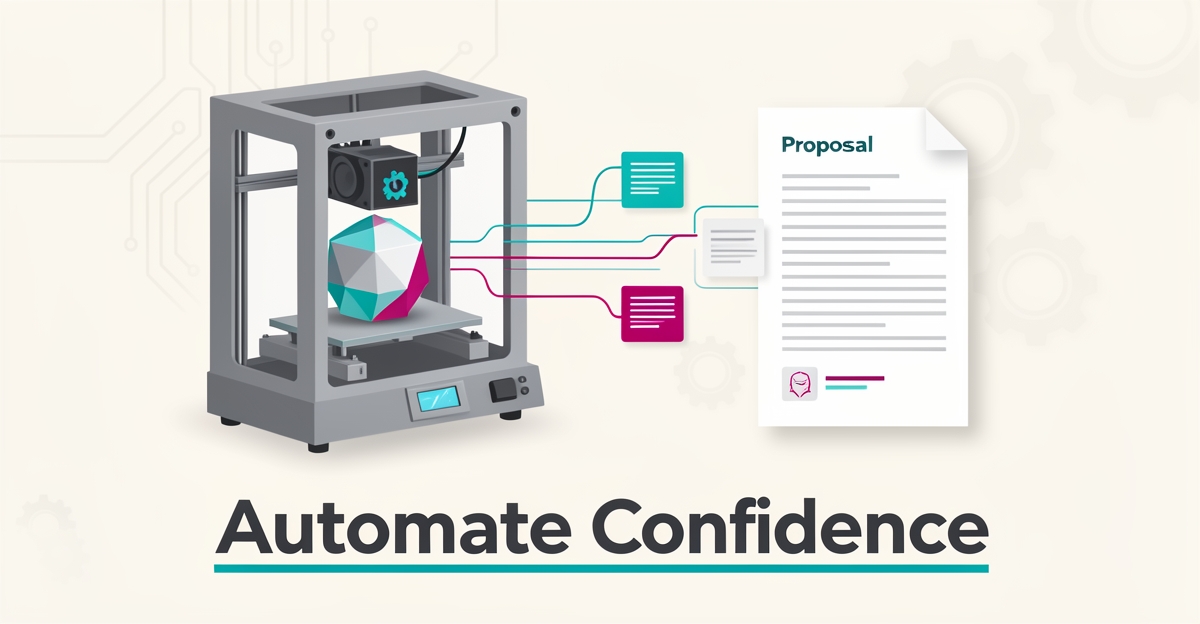
Key facts
- The 3D printing market reached $22.14B in 2023 with 26.8% year-over-year growth according to Protolabs' survey of 700+ engineers and manufacturers
- 70% of businesses printed more parts in 2023 than 2022 per Protolabs' trend report
- 47% of buyers choose 3D printing primarily for lead time up from 44% a year earlier
- 82% of businesses report substantial cost savings from additive manufacturing in their manufacturing pipeline
- MIT's MechStyle AI boosted structural viability from 26% to 100% through material-aware physics simulation
- End-use parts now represent 21% of all prints, with 6.2% of shops running 1,000+ parts annually showing production shift accelerating
- No current AI tools generate client-facing 3D print job descriptions despite 33% expecting AI impact at hardware level
WANT RESULTS LIKE THIS?
Imagine a system doing all of this for your local business — every day, without you.
We build local businesses a custom website with a team of AI behind it: every lead captured and followed up, new content published monthly,customers finding you on Google — live in 7 days.
- 85+ pages at launch
- Every lead followed up, automatically
- Your whole business on one screen
The 3D Print Transparency Gap
The 3D printing services market hit $22.14 billion in 2023 with 26.8% year-over-year growth, and 70% of businesses are printing more parts than they did a year ago according to Protolabs' survey of 700+ engineers and manufacturers. Yet for local print shops and service bureaus, every new inquiry triggers the same manual scramble: clients want to know what the finished part will look like, which material suits their application, how long the print will take, and what it will cost — before they commit.
- 47% of buyers choose 3D printing primarily for lead time (up from 44% a year earlier)
- 82% report substantial cost savings from additive manufacturing in their pipeline (Protolabs trend report)
- End-use parts now represent 21% of all prints, with 6.2% of shops running 1,000+ parts annually (production shift accelerating)
Translating slicer output — layer height, support volume, material weight, estimated print hours — into a clear, client-ready description eats hours each week. Most shops still copy-paste from spreadsheets or type fresh replies for every quote. The AI tools dominating the market today generate models (text-to-3D, image-to-3D) or validate structural viability like MIT's MechStyle, but none bridge the gap between slicer data and the polished job description a local client expects. AI Business Sites approaches this differently: the platform uses local input — your materials, your processes, your pricing logic — to generate tailored, accurate job descriptions in real time, cutting the manual workload and giving clients the transparency that builds confidence to approve and move forward.
AI-Powered Solution for Tailored Job Descriptions
AI-Powered Solution for Tailored 3D Print Job Descriptions
In the rapidly expanding 3D printing market, projected to reach $57.1B by 2028 at a 21% CAGR, efficiency and client communication are critical for small businesses. According to industry research, 47% of businesses choose 3D printing for its lead time benefits, and 82% report substantial cost savings. However, a significant gap exists: the lack of AI tools to generate client-facing job descriptions automatically.
Leveraging AI for Client Confidence
AI Business Sites proposes an AI module that integrates slicer data, material specifications, and model metadata to generate tailored job descriptions. This approach aligns with the platform's use of local input for real-time, accurate content generation. By incorporating insights from MIT's MechStyle, which achieves up to 100% structural viability through material-aware simulation, the module can provide detailed, client-focused summaries.
Key Components of the AI Solution
- Material-Aware Descriptions: Utilize a material knowledge base to include property-specific guidance (e.g., "PLA parts have a matte finish, suitable for indoor use up to 50°C").
- Industry-Specific Templates: Offer tailored templates for verticals like dental (emphasizing biocompatibility) and HVAC/plumbing (highlighting heat resistance). For example, a dental client might receive: "This SLA resin part is biocompatible, requires UV post-curing, and offers high detail for precise dental applications."
- Human-in-the-Loop Review: Ensure accuracy with confidence-scored drafts, flagging novel or high-risk elements for human approval, mirroring AI Business Sites' "approve-first" autonomy model.
Integration for Seamless Workflow
Generated job descriptions will be seamlessly integrated into AI Business Sites' client approval portals and project management workflows. This automation eliminates manual work, as highlighted in the research brief, and enhances client confidence through transparent, detailed job summaries. For instance, upon approval, the system can auto-create projects with predefined print parameters, streamlining the production process.
Market Validation
The absence of current tools addressing automatic job description generation, combined with the growing demand for efficient 3D printing services, validates the market opportunity. With 70% of businesses printing more parts year-over-year, as noted in Protolabs' trend report, the potential for automated, client-centric solutions is clear.
By addressing this gap, AI Business Sites can further differentiate its platform, offering small businesses a unique advantage in delivering transparent, efficient 3D print services tailored to local client needs.
Implementing Effective AI-Generated Descriptions
Turning technical slicer data into a clear client proposal is often the most tedious part of the 3D printing workflow. By automating this translation, you can bridge the gap between complex engineering and client confidence.
The first step is integrating material-aware simulations. Since research from MIT shows that AI can increase structural viability from 26% to 100%, your descriptions should reflect these physics-based realities.
Avoid generic summaries by using industry-specific templates. Because technology preferences vary by vertical—with medical uses 40% SLA and automotive 20% SLS—your AI needs to pivot its language based on the client's industry.
- Dental/Medical: Focus on biocompatibility, precision, and regulatory compliance.
- HVAC/Plumbing: Emphasize heat resistance, chemical durability, and functional testing.
- Manufacturing: Highlight lead times and cost-per-unit at volume.
- Consumer Goods: Focus on surface finish and sustainability credentials.
To ensure total accuracy, implement a human-in-the-loop review process. This mirrors the autonomy model used by AI Business Sites, where the AI proactively drafts the content but the business owner approves it before it reaches the customer.
This safety layer is critical because industry experts note that many current printers are "dumb" and fail to specify exactly what is wrong during a print. A human review ensures the AI isn't hallucinating a timeline or material property.
Finally, connect these descriptions to an automated approval workflow. By sending a generated description through a client-facing approval portal, you eliminate manual back-and-forth emails.
Once the client signs off on the description, the system can automatically trigger the project setup. This transforms a manual administrative burden into a seamless pipeline that scales with your growth.
Local business: doing this the old way?
One system replaces the whole pile.
All of it — the website, the follow-up, the content, the leads — built and run for you for $1,497 + $497/mo. Month-to-month, and you own everything.
See what your build includesIntegration with Business Operations for Seamless Workflow
In the rapidly growing 3D printing market, projected to reach $57.1B by 2028 at a 21% CAGR, efficiency and client trust are paramount. AI Business Sites' platform addresses this by integrating AI-generated 3D print job descriptions seamlessly into business operations, eliminating manual handoffs and enhancing client trust.
Automating the Workflow
- From Description to Approval: AI-generated
Overcoming Challenges and Future Development
As the adoption of AI-generated 3D print job descriptions gains traction, several challenges must be addressed to ensure accuracy, client satisfaction, and seamless integration with existing workflows. Client feedback loops are crucial; for instance, if a client queries the material's heat resistance, the AI should learn to prioritize this detail in future descriptions (as seen with MechStyle's material-aware simulations, https://news.mit.edu/2026/genai-tool-helps-3d-print-personal-items-sustain-daily-use-0114). Meanwhile, accuracy concerns can be mitigated through human-in-the-loop review processes, where confidence scores flag potentially inaccurate estimates for manual verification.
The one system philosophy of AI Business Sites, which integrates website, CRM, project management, and now potentially AI-driven 3D print job descriptions, positions the platform to streamline these challenges. By leveraging local input and client interaction data, the AI can refine its understanding of what constitutes a "detailed" description, adapting to the specific needs of plumbing, HVAC, electrical, and other local service businesses.
- Accuracy and Transparency:
- Challenge: Ensuring AI-generated descriptions accurately reflect print outcomes, especially for complex geometries or novel materials.
-
Solution: Implement confidence scoring with human review for low-confidence sections, and integrate with platforms like MechStyle for structural viability checks source.
-
Client Feedback Integration:
- Challenge: Incorporating client preferences and feedback to improve description relevance.
-
Solution: Utilize the AI Business Sites’ built-in client feedback mechanisms to update job description templates and content priorities dynamically.
-
Industry-Specific Customization:
- Challenge: Catering to the diverse needs of various industries (e.g., medical, automotive, agricultural).
- Solution: Develop and continuously update industry-specific description templates based on sector trends and client feedback, such as highlighting biocompatibility for dental or heat resistance for HVAC parts.
Based on the research gaps and the platform's integrated approach:
- 1. Enhanced Material Database:
- Need: A comprehensive, updateable database of materials with detailed properties (e.g., thermal resistance, biodegradability) to improve description accuracy.
-
Example: Including PLA's moisture sensitivity or SLA's UV curing needs in descriptions.
-
2. Integration with Emerging AI Tools:
- Need: Seamless integration with next-gen AI tools for model generation, slicer optimization, and post-processing prediction to enhance description completeness.
-
Example: Combining with AMAIZE for reduced support structures and cost savings source.
-
3. User Testing and Iteration:
- Need: Extensive user testing with small business owners and clients to refine the description format, content, and the overall workflow.
- Statistic: Given 70% of businesses print more parts year-over-year source, iterative feedback will be crucial for meeting recurring client needs.
The research underscores a high confidence in the market need and technical feasibility of AI-generated 3D print job descriptions, validated by:
- Rapid 3D printing market growth (projected to reach $57.1B by 2028 at 21% CAGR, https://www.protolabs.com/resources/guides-and-trend-reports/3d-printing-trend-report/).
- Identified gap in current AI tool capabilities.
- Alignment with AI Business Sites’ one system philosophy, streamlining client communication and project management.
As the platform evolves, addressing the outlined challenges and development needs will be pivotal in maintaining client trust and driving adoption among local service businesses. By focusing on accuracy, feedback, and customization, AI Business Sites can solidify its position in automating client confidence for 3D print services.
Frequently Asked Questions
Why is it so hard to get clear job descriptions for 3D print jobs?
Can AI actually generate accurate 3D print job descriptions for my clients?
How do I know the AI won't hallucinate print times or material specs?
Will AI-generated descriptions work for my specific industry, like dental or HVAC?
What happens after a client approves an AI-generated job description?
Is there really a market need for this, or is it just another AI feature?
Key Takeaways
{ "title": "Automate Transparency, Amplify Trust: The Future of 3D Print Services", "content": "As the 3D printing market surges towards $57.1B by 2028, local print shops face a persistent challenge: manually crafting detailed job descriptions that build client confidence. By leveraging AI to au
FOR local businesss — BUILT AND RUN BY US
Your website. Your content. Your leads. Your data.
$500 starts your build. Seven days later it's live — chat, booking, follow-up, and your Google presence all set up. Then we run it, every month. You do the work you actually get paid for.