
Key facts
- Construction firms lose 15-25% of viable bid opportunities due to missed deadlines and process gaps according to industry research
- Automation reduces bid coordination time by 75-85% — from 8-12 hours to just 1-2 hours weekly per research on 30-50 bid workflows
- Mid-sized contractors miss 2-3 bid windows monthly, each worth $50K-$500K in lost revenue based on bid management analysis
- 40-60% of bid submissions receive zero post-submission follow-up, leaving money on the table per bid process research
- Unified digital estimating systems boost bid-win ratios by 32% and profit margins by up to 25% versus manual processes
- Automated takeoff and shared templates cut estimating cycle time by up to 90% enabling 2x opportunity capacity
- 61% of construction cost overruns originate in preconstruction — before ground breaks per industry analysis
WANT RESULTS LIKE THIS?
Imagine a system doing all of this for your local business — every day, without you.
We build local businesses a custom website with a team of AI behind it: every lead captured and followed up, new content published monthly,customers finding you on Google — live in 7 days.
- 85+ pages at launch
- Every lead followed up, automatically
- Your whole business on one screen
The Bid Management Bottleneck: Manual Intake Challenges
The back-and-forth emails, the missing blueprints, the deadline that slipped by unnoticed — manual bid intake doesn't just slow you down. It quietly costs you work. Construction firms lose 15-25% of viable bid opportunities due to missed deadlines, late submissions, or pricing errors, according to industry research on bid management automation. For a mid-sized general contractor juggling 30 to 50 active bids a month, that translates to two or three missed bid windows — each potentially worth $50K to $500K in revenue.
The productivity drain is measurable. Estimators and coordinators spend 8 to 12 hours a week just managing the intake process: logging invitations, chasing documents, tracking deadlines, and manually entering data into estimating tools. Automation cuts that to 1 to 2 hours — a 75-85% reduction in coordination time. But the hidden costs run deeper. Stale material pricing creeps into winning bids one to two times a month, eroding margins by 3 to 8%. Late takeoffs force rushed estimates three to five times monthly. And 40 to 60% of submissions go out with no post-submission follow-up, leaving money and relationships on the table.
- Missed bid invitations buried in email or portal notifications
- Incomplete project specs requiring multiple clarification rounds
- Deadline tracking spreadsheets that fall out of date
- Manual data entry errors that propagate into estimates
- No systematic follow-up after submission to gauge interest or clarify scope
These aren't abstract inefficiencies — they're the daily reality for estimating firms running on email threads and shared drives. The research is clear: firms automating bid capture, deadline tracking, and follow-up sequences don't just save time. They win more of the right jobs. At AI Business Sites, we've seen how custom websites with built-in automation turn this chaotic front end into a structured, trackable process — capturing project details, blueprints, and client requirements through automated forms before an estimator ever opens a spreadsheet.
Solving the Bottleneck: Automation Solutions for Bid Requests & Client Intake
Estimating firms lose 15-25% of viable bid opportunities due to process gaps like missed deadlines and late submissions, a significant revenue drain that automation directly addresses. Research shows firms managing 30-50 bids monthly can reduce bid coordination time from 8-12 hours to just 1-2 hours weekly through a structured automation approach, freeing estimators to focus onEstimating firms lose 15-25% of viable bid opportunities due to process gaps like missed deadlines and late submissions, a significant revenue drain that automation directly addresses. Research shows firms managing 30-50 bids monthly can reduce bid coordination time from 8-12 hours to just 1-2 hours weekly through a structured automation approach, freeing estimators to focus on high-value work instead of chasing paperwork.
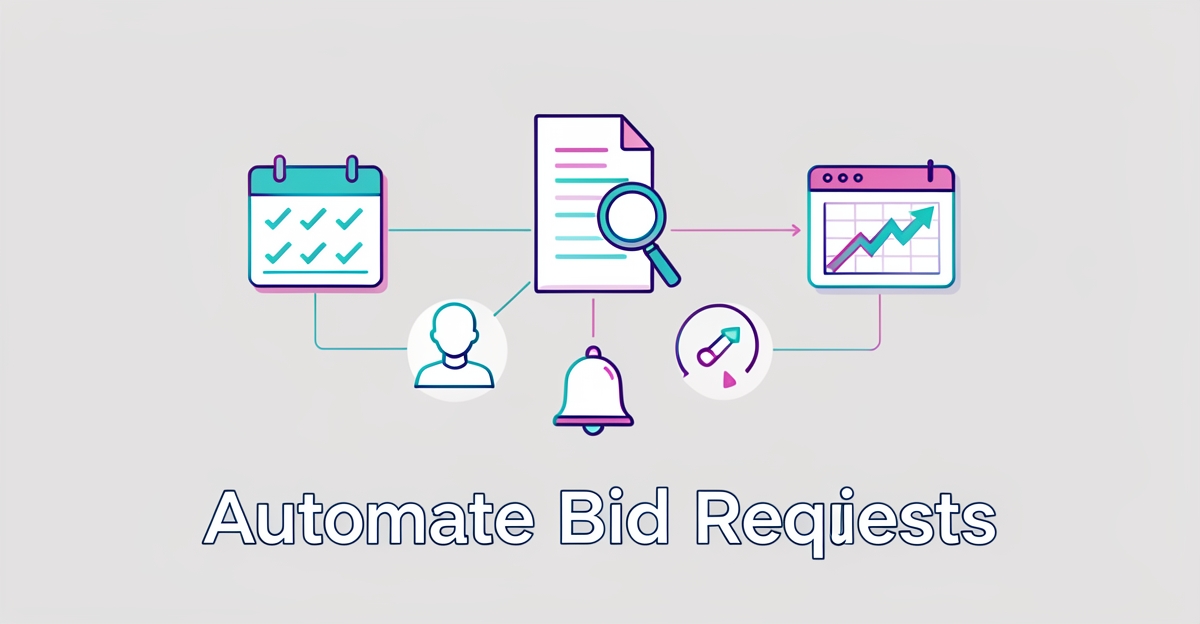
The proven 5-step framework begins with automatically capturing bid invitations from email and client portals, eliminating manual forwarding and lost attachments. Next, set and track submission deadlines with milestone reminders to prevent the 2-3 missed bid windows per month that typically cost $50K-$500K each in lost revenue. Automate material pricing updates from accounting systems to correct the 1-2 incorrect pricing occurrences monthly that erode margins by 3-8% on winning bids. Trigger post-submission follow-up sequences to address the 40-60% of submissions that currently receive no follow-up, improving win-to-work alignment. Finally, log outcomes for win/loss intelligence to refine future bidding strategies.
- Automatic bid invitation capture from email and portals
- Deadline tracking with milestone reminders
- Automated material pricing updates
- Post-submission follow-up sequences
- Outcome logging for win/loss intelligence
AI-powered tools enhance this framework by analyzing RFPs for requirement extraction, compliance tracking, and risk detection—enabling evidence-backed Go/No-Go decisions. However, research reveals a critical gap in client-facing intake automation: while internal workflows are well-covered, solutions for gathering blueprints and specifications directly from clients remain underdeveloped. Addressing this requires online booking systems that let clients schedule site visits or consultations instantly, paired with automated forms that collect project details, upload specifications, and trigger estimate workflows without back-and-forth emails. Implementing these tools creates a seamless intake experience where estimators receive complete project information the moment a client engages, removing the manual delays that slow down bidding and improving the estimator-client relationship from the first interaction. AI Business Sites integrates these capabilities directly into custom websites, ensuring the intake process works as smoothly as the automated bid management behind it.
Local business: doing this the old way?
One system replaces the whole pile.
All of it — the website, the follow-up, the content, the leads — built and run for you for $1,497 + $497/mo. Month-to-month, and you own everything.
See what your build includesImplementing Automated Bid Management & Client Intake: Step-by-Step Guide
Automate Bid Requests & Client Intake for Estimating Firms: A 5-Step Guide
Implementing Automated Bid Management & Client Intake: Step-by-Step Guide
In the competitive landscape of estimating firms, manual bid request and client intake processes can lead to missed opportunities, delayed submissions, and reduced profitability. According to industry research, construction firms lose 15-25% of viable bid opportunities due to process gaps, emphasizing the need for automation.
Begin by automating the capture of bid invitations from emails and portals, and set up deadline tracking with milestone reminders. This step alone can reduce bid coordination time by 75-85% (from 8-12 hours to 1-2 hours weekly) for firms managing 20+ active bids monthly (source).
Integrate your automated bid management system with estimating software that offers API connectivity, such as STACK, to eliminate manual data entry and improve estimate consistency. Unified digital systems can increase estimators' capacity to pursue opportunities by 2x and improve bid-win ratios by 32% (Linarc Buildspace).
Utilize AI-powered bidding tools for RFP analysis, compliance automation, and risk detection. These tools can reduce manual effort in opportunity qualification and proposal preparation, enabling evidence-backed Go/No-Go decisions (ContraVault).
Implement online booking systems and automated forms specifically designed for gathering project blueprints and specifications from clients. While extensively documented in internal workflow automation, this front-end client intake mechanism is crucial for removing manual back-and-forth in the estimator-client relationship.
Adopt unified digital estimating systems to achieve up to 90% reduction in estimating cycle time through automated takeoff and shared bid templates. This approach can also improve profit margins by up to 25% versus manual processes (Linarc Buildspace).
Key Takeaways for Estimating Firms:
- Reduce bid coordination time by 75-85% through automation.
- Integrate with estimating software for seamless data flow and improved consistency.
- Leverage AI for enhanced RFP analysis and compliance automation.
By following these steps and addressing the client-facing intake gap, estimating firms can significantly enhance their bidding process efficiency, reduce errors, and improve win rates. As highlighted by US Tech Automations, having a consistent estimating process is key to successful automation, amplifying good habits and exposing inconsistencies. AI Business Sites understands the importance of streamlining these initial phases, offering tailored solutions for small businesses, including custom website design and integrated business operations platforms that can support automated bid management and client intake processes.
Automate, Streamline, and Grow with AI-Powered Solutions
Frequently Asked Questions
How much revenue can construction firms lose due to manual bid intake process gaps?
What is the typical time reduction in bid coordination with automation?
Why is client-facing intake automation crucial for estimating firms?
How does AI enhance the bid management process for estimating firms?
What is the impact of unified digital estimating systems on productivity and profitability?
Why is having a consistent estimating process important for automation success?
Automate, Elevate: Unlocking Estimating Firm Efficiency
By embracing automation in bid requests and client intake, estimating firms can break free from the productivity shackles of manual processes, recapturing up to 25% of lost bid opportunities and slashing coordination time by 75-85%. As highlighted by research source, the key to success lies in a structured 5-step automation approach, unified digital estimating systems, and addressing the overlooked yet critical client-facing intake gap. For estimating firms, the next step is clear: adopt AI-powered bidding tools, integrate with estimating software, and implement online booking systems with automated forms. By doing so, not only will you streamline your operations but also position your firm for sustained growth and competitiveness. Take the first step today towards transforming your estimating process with AI Business Sites, where custom solutions meet the needs of modern estimating firms.
FOR local businesss — BUILT AND RUN BY US
Your website. Your content. Your leads. Your data.
$500 starts your build. Seven days later it's live — chat, booking, follow-up, and your Google presence all set up. Then we run it, every month. You do the work you actually get paid for.