
Key facts
- Google Business Profile allows up to 20 service areas defined by cities or postal codes — not radius — for service-area businesses according to Market My Market
- Personalized CTAs perform 202% better than generic ones, dramatically increasing conversion rates for local service pages per Matomo's conversion research
- Companies with 40+ landing pages increase conversions by 500%+ compared to those with fewer pages according to Matomo's statistics
- Industry best practices require 40–60% unique-value content per neighborhood page — not copy-paste templates with city names swapped per Market My Market's guidelines
- Google's spam policies explicitly flag 'blocks of text that list cities and regions' as keyword stuffing violations according to Google's published guidance
- User-generated content exposure increases conversion likelihood by 102.4% when encountered on service pages per Matomo's research
- Reviews make consumers 85% more likely to buy, testimonials 82%, and star ratings 78% — trust signals that drive local conversions according to Matomo's data
WANT RESULTS LIKE THIS?
Imagine a system doing all of this for your local business — every day, without you.
We build local businesses a custom website with a team of AI behind it: every lead captured and followed up, new content published monthly,customers finding you on Google — live in 7 days.
- 85+ pages at launch
- Every lead followed up, automatically
- Your whole business on one screen
The Visibility Gap in Halifax Neighborhoods
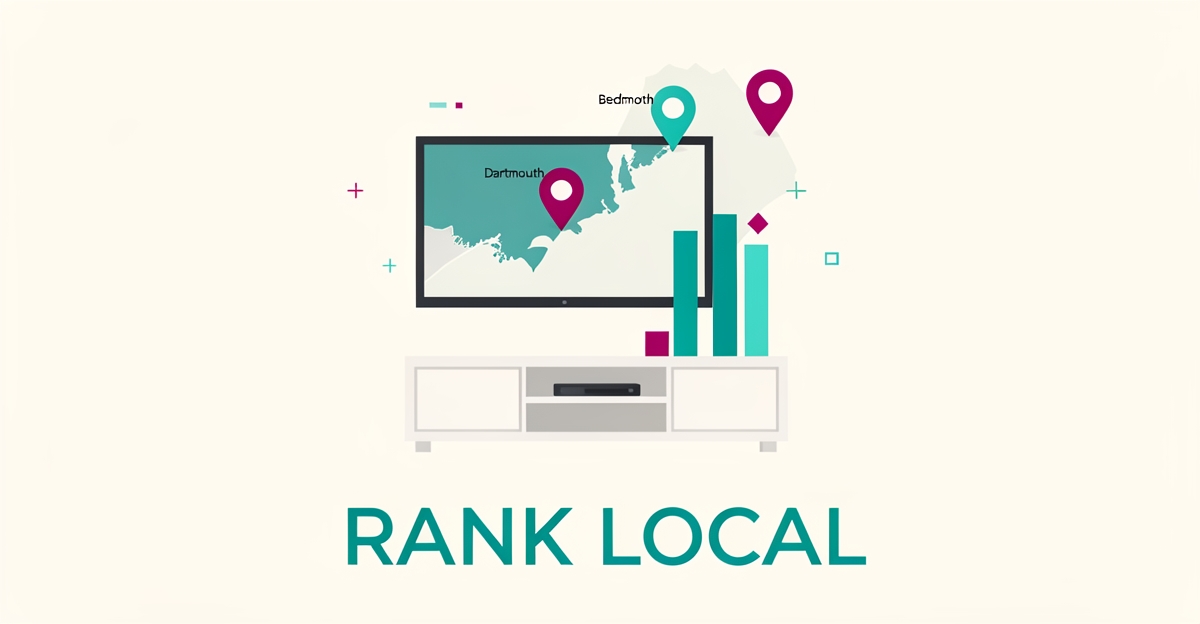
When a homeowner in Bedford searches "TV mounting near me," they're not looking for a business that claims to "serve Halifax" — they want to know if you'll actually show up at their door. Google's local pack favors businesses with physical addresses in the searched city, which means a Halifax-based TV mounting service often disappears from the 3-pack for Dartmouth or Bedford queries entirely. Strong Service Area Pages (SAPs) can increase visibility in the organic results beneath that local pack for these outlying areas, according to BrightLocal's local SEO research.
- Google Business Profile allows up to 20 service areas defined by cities or postal codes — not radius — with boundaries generally not exceeding a two-hour drive from your base
- Industry best practices call for 40–60% unique-value content per neighborhood page — not copy-paste templates with city names swapped
- Google's spam policies explicitly flag "blocks of text that list cities and regions" as keyword stuffing
A "Geo Hub" architecture — a browseable Service Areas hub page linking to individual neighborhood pages — creates clear hierarchy and multiple local entry points while reducing doorway abuse risk, as recommended by Market My Market. Each SAP should feature neighborhood-specific trust signals: local testimonials, landmarks like Bedford Place Mall or Dartmouth Crossing, area-specific installation challenges, and personalized CTAs. Conversion research shows personalized CTAs perform 202% better than generic ones, and companies with 40+ landing pages increase conversions by 500%+. AI Business Sites builds this structure automatically at launch with 60+ SEO pages, then adds monthly location-specific content that builds topical authority for each Halifax neighborhood — all while keeping your GBP service area settings and website coverage maps perfectly aligned.
Evidence-Based Solution: Optimized Service Area Pages (SAPs)
Google's local pack favors businesses with physical addresses in the searched city, which means a Halifax-based TV mounting service often disappears from the 3-pack for Bedford or Dartmouth searches. Well-optimized Service Area Pages (SAPs) close that gap by earning visibility in organic results beneath the local pack for those outlying neighborhoods. The strategy isn't about listing cities — it's about proving local relevance at the page level without implying a storefront exists everywhere.
Research from BrightLocal confirms that SAPs help service-area businesses appear for region-specific searches without a brick-and-mortar location, acting as local landing pages that spotlight offerings in targeted communities. Market My Market emphasizes that Google Business Profile allows up to 20 service areas defined by cities or postal codes — not radius — and website SAPs must stay consistent with that configuration to send clear signals to search engines. A "Geo Hub" architecture with a browseable "Service Areas" page linking to individual neighborhood pages creates multiple local entry points while reducing doorway abuse risk.
- Unique, high-value content per neighborhood (40–60% unique-value threshold) — not copy-paste templates with city names swapped
- Visual coverage maps aligned with GBP service area settings to reduce customer confusion
- Neighborhood-specific trust signals: local testimonials, landmarks, building codes, and personalized CTAs
- Internal linking from homepage through Geo Hub to each SAP and key service pages
Personalized CTAs perform 202% better than generic ones, and companies with 40+ landing pages increase conversions by 500%+ compared to those with fewer pages. Trust signals drive action: reviews make consumers 85% more likely to buy, testimonials 82%, and star ratings 78%. AI Business Sites automates this entire structure at launch — generating 60+ SEO pages with proper Geo Hub architecture, internal linking, and GBP alignment — then continues publishing monthly location pages that build topical authority for each Halifax neighborhood. The platform also handles ongoing GBP optimization, including review management and competitor analysis, so your service area presence strengthens automatically over time.
Implementation Roadmap for Halifax TV Mounting Services
Building Service Area Pages that actually convert takes more than swapping neighborhood names into a template. Google's local pack favors businesses with physical addresses in the searched city, which means a Halifax-based TV mounting service may not appear in the 3-pack for Bedford or Dartmouth queries — strong SAPs can increase visibility in organic results beneath that local pack for those outlying areas. The solution is a structured rollout that aligns your website, Google Business Profile, and ongoing content around the neighborhoods you genuinely serve.
Start with a "Geo Hub" architecture: a browseable Service Areas page linking to individual SAPs for Bedford, Dartmouth, and other Halifax communities. This hierarchy reduces doorway abuse risk and creates multiple local entry points into your site, a structure the AI Business Sites platform automates at launch with 60+ SEO pages. Each neighborhood page needs 40–60% unique-value content — local landmarks like Bedford Place Mall or Dartmouth Crossing, area-specific installation challenges such as condo mounting restrictions, and neighborhood testimonials that prove you know the area. Personalized CTAs like "Book Your Bedford Installation Today" outperform generic ones by 202%, and companies with 40+ landing pages increase conversions by 500%+ compared to those with fewer pages.
- Map your actual service zones (up to 20 cities/postal codes) in Google Business Profile — not radius — and mirror those boundaries on an interactive coverage map
- Build unique SAPs for each target neighborhood with local trust signals: reviews, licenses, guarantees, and transparent process details
- Direct paid ads to relevant neighborhood SAPs instead of the homepage for better ad performance and organic engagement signals
- Publish ongoing monthly location pages that deepen topical authority for each community over time
The AI Business Sites platform handles the heavy lifting: GBP setup and optimization at launch, automated internal linking between hub and neighborhood pages, and an AI content engine that researches and publishes new location-specific content every month. Your website becomes a self-reinforcing local SEO asset — answering "TV mounting near me" searches from Bedford to Dartmouth with pages that feel specifically tailored to each homeowner.
Local business: doing this the old way?
One system replaces the whole pile.
All of it — the website, the follow-up, the content, the leads — built and run for you for $1,497 + $497/mo. Month-to-month, and you own everything.
See what your build includesMeasuring Success: Conversion Rate Optimization for SAPs
Measuring Success: Conversion Rate Optimization for TV Mounting Services in Halifax
Unlocking the full potential of your TV mounting service's website in Halifax hinges on more than just attracting visitors - it's about converting them into clients. According to Matomo's conversion rate statistics, personalized approaches significantly outperform generic ones, with personalized CTAs performing 202% better than basic calls-to-action. Moreover, user-generated content can increase conversion likelihood by a staggering 102.4% when encountered.
- Neighborhood-Specific Testimonials: Highlighting testimonials from satisfied clients in specific neighborhoods like Bedford or Dartmouth fosters trust. For example, a testimonial might read, "Quick and professional TV mounting service in my Dartmouth condo — highly recommended!"
- Transparent Service Process: Clearly outlining your mounting process, from consultation to installation, especially highlighting any neighborhood-specific challenges (e.g., condo regulations in Halifax), builds credibility.
-
Local Landmarks and References: Mentioning service near recognizable local landmarks (e.g., "TV mounting services near Bedford Place Mall") helps visitors immediately understand your relevance to their area.
-
Location-Specific CTAs: Instead of a generic "Book Now," use "Schedule Your Bedford TV Mounting Today" to match the visitor's likely search intent.
-
Device-Optimized CTAs: Ensure CTAs are prominently displayed and easily clickable on both desktop and mobile, given desktop conversion rates (3%) outperform mobile (2%) in many industries.
-
Client Photos and Reviews: Encourage and showcase photos of your work in different Halifax neighborhoods, alongside reviews, to build trust and authenticity.
- UGC in SAPs: Incorporate UGC directly into Service Area Pages (SAPs) for Bedford, Dartmouth, etc., to increase conversion likelihood.
AI Business Sites streamlines this process by:
- Automatically Generating SAPs with unique, neighborhood-focused content and CTAs.
- Integrating Trust Signals seamlessly into each page.
- Facilitating UGC Collection through its built-in review management and content generation capabilities, ensuring a constant flow of fresh, converting content.
By focusing on these conversion rate optimization strategies, your TV mounting service in Halifax can significantly enhance its website's effectiveness, turning more visitors into valued clients across the Halifax metropolitan area.
Conversion Rate Optimization Checklist for TV Mounting Services:
- Implement neighborhood-specific, personalized CTAs (e.g., "Book Your Dartmouth TV Mounting")
- Embed trust signals (local testimonials, transparent process, landmarks) in all Service Area Pages
- Incorporate user-generated content (client photos, reviews) into SAPs for increased conversions
According to Matomo's statistics, even a small increase in conversion rate can dramatically impact revenue, making these strategies crucial for competitive local service businesses.
Avoiding Common Pitfalls: Google’s Spam Policies and Best Practices
Building service area pages that actually convert requires more than listing neighborhoods — it demands a strategy that respects Google's quality thresholds. The search engine's spam policies explicitly flag doorway abuse and scaled content abuse as violations, with "blocks of text that list cities and regions" called out as a keyword stuffing example. Businesses that copy-paste the same page with only the neighborhood name swapped risk manual penalties and wasted crawl budget. According to local SEO experts, the competitive advantage now belongs to those publishing fewer, stronger pages that function as true destination content.
- Create unique, high-value pages with 40–60% unique-value content per neighborhood — not synonym rewrites
- Build a "Geo Hub" architecture linking a central Service Areas page to individual neighborhood pages
- Align website coverage maps with Google Business Profile settings (up to 20 cities/postal codes)
- Feature neighborhood-specific trust signals: local testimonials, landmarks, and area-specific CTAs
- Avoid listing every possible town — focus on meaningful markets you genuinely serve
BrightLocal emphasizes that a homeowner wants to see you know their area — mentioning local building codes, landmarks like Bedford Place Mall, or Dartmouth Crossing installation challenges builds the trust that drives conversions. Research shows personalized CTAs perform 202% better than generic ones, and companies with 40+ landing pages increase conversions by 500%+. Trust signals like reviews (85% more likely to buy) and testimonials (82%) make the difference between a visitor and a lead. AI Business Sites structures every launch around this compliant architecture — generating 60+ SEO pages at setup with ongoing monthly content that builds genuine topical authority for each Halifax neighborhood, all while keeping GBP configuration and website content in perfect alignment.
Frequently Asked Questions
Why do Halifax-based TV mounting services often disappear from Google's 3-pack for outlying neighborhood searches (e.g., Bedford, Dartmouth)?
What is the recommended structure for Service Area Pages (SAPs) to avoid Google's spam policies and improve local SEO?
How effective are personalized CTAs compared to generic ones in converting visitors?
Can Service Area Pages (SAPs) really outrank large directories like Yelp or HomeAdvisor?
What is the maximum number of service areas Google Business Profile (GBP) allows, and how should they be defined?
How do trust signals impact conversion rates for local service businesses?
Key Takeaways
{ "title": "Map Your Way to More Clients: The Power of Location-Specific Strategy", "content": "By embracing a location-specific strategy with well-optimized Service Area Pages (SAPs), TV mounting services in Halifax can effectively bridge the visibility gap in neighborhoods like Bedford and Dar
FOR local businesss — BUILT AND RUN BY US
Your website. Your content. Your leads. Your data.
$500 starts your build. Seven days later it's live — chat, booking, follow-up, and your Google presence all set up. Then we run it, every month. You do the work you actually get paid for.