
Key facts
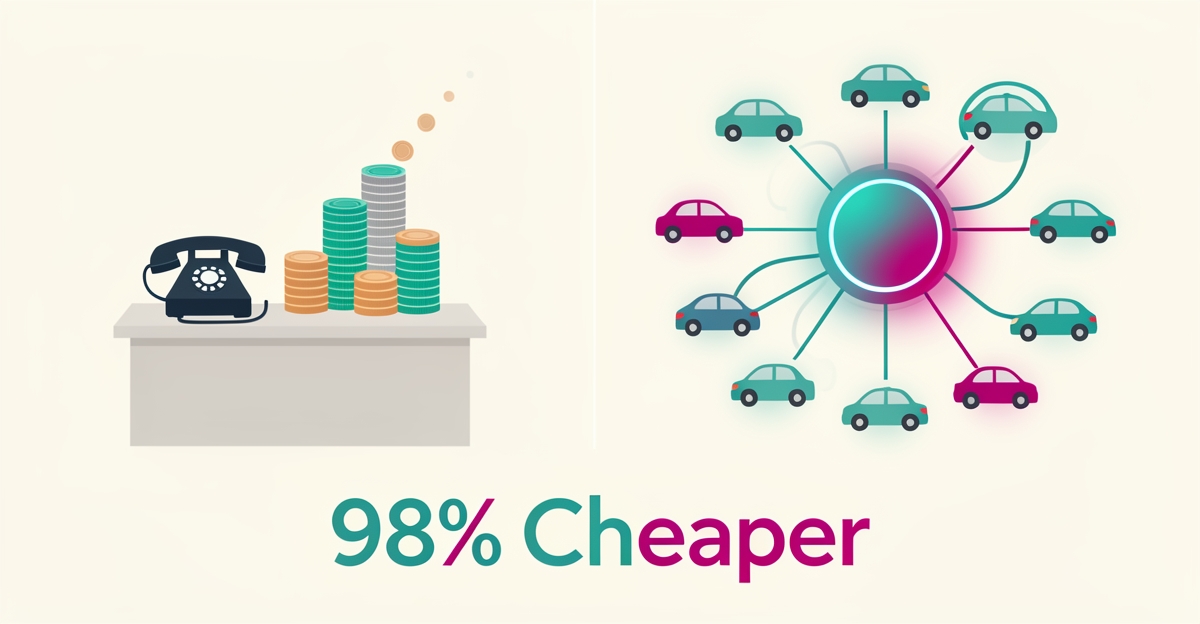
- AI dispatch reduces costs by up to 98.7% compared to in-house dispatchers according to industry research
- Human dispatchers' true cost is 1.25–1.4x their salary due to hidden expenses as shown in cost analysis
- AI handles unlimited simultaneous calls with per industry benchmarks
- 67% of consumers prefer AI for simple transactions due to faster response times based on consumer preference data
- Fleet utilization improves 5–20% with AI dispatch handling routing logic per fleet operator reports
- Implementation of AI dispatch typically takes 6–10 weeks according to deployment timelines
- AI dispatch enables 24/7 coverage without scheduling gaps or overtime costs as demonstrated in operational case studies
WANT RESULTS LIKE THIS?
Imagine a system doing all of this for your local business — every day, without you.
We build local businesses a custom website with a team of AI behind it: every lead captured and followed up, new content published monthly,customers finding you on Google — live in 7 days.
- 85+ pages at launch
- Every lead followed up, automatically
- Your whole business on one screen
The Hidden Cost of Human Dispatchers (That Most Owners Miss)
The moment you realize your dispatcher’s salary is just the beginning of what they cost you, it’s too late. The real expense of an in-house dispatch team isn’t reflected on your payroll ledger—it’s buried in the dozens of hidden costs that quietly inflate your operational overhead without adding a single minute of productive dispatch time.
Human dispatchers come with a fully loaded cost that can reach 1.25 to 1.4 times their base salary once you factor in payroll taxes, benefits, training, turnover, and the inevitable inefficiencies of single-tasking. Industry research shows that a dispatcher earning $45,000 annually actually costs closer to $56,000 to $63,000 when you account for health insurance, retirement contributions, paid time off, and the hidden expense of onboarding—costs that repeat every hire. But the real damage isn’t just financial—it’s operational.
- Every missed call costs you a customer. Human dispatchers can’t handle more than one conversation at a time, which means during peak hours or when multiple lines ring simultaneously, calls go unanswered—leading to a 15–30% abandoned call rate.
- Your dispatcher’s availability is limited by their working hours. Nights, weekends, and holidays still demand coverage, but scaling staff to meet unpredictable demand inflates labor costs without improving service consistency.
- Training isn’t a one-time cost. Dispatchers need ongoing coaching to stay current with routing software, local traffic patterns, and customer service protocols—each session pulls them away from the phones and drains your margins.
- Turnover is inevitable. When a dispatcher leaves, you not only lose institutional knowledge, but you also absorb recruitment costs, temporary staffing fees, and the time it takes for a replacement to reach full productivity—often 30 to 90 days of lost efficiency.
Even when your dispatcher is “on,” their efficiency is constrained by human limitations. Unlike AI systems, which can manage unlimited simultaneous calls with a consistently under 2% abandoned call rate, human agents reach cognitive saturation quickly. The result? Slower response times, inconsistent service quality, and a direct hit to customer satisfaction—especially during the 67% of simple booking requests where consumers now prefer AI due to faster response times.
At AI Business Sites, we’ve seen taxi operators cut dispatch overhead by up to 98.7% by shifting routine bookings, status updates, and routing to an automated system—while keeping human oversight for nuanced customer interactions. The savings aren’t just in salaries; they’re in scalability, consistency, and the ability to serve every customer, every time, without adding headcount. When your website handles the busywork of dispatch, your dispatcher isn’t obsolete—their role shifts to where it adds real value.
How AI Dispatch Cuts Costs by 98% Without Sacrificing Service
The math behind dispatch costs changes fast when you stop paying for downtime. A mid-sized taxi company can cut dispatch expenses by up to 98.7% by switching to an AI-powered system, according to industry cost analysis. That gap exists because human dispatchers carry hidden overhead — benefits, training, turnover, and the simple fact that one person can only handle one call at a time. The fully loaded cost of an in-house dispatcher runs 1.25 to 1.4 times their stated salary once those factors are included.
AI dispatch removes the bottleneck entirely. The system answers unlimited simultaneous calls with an abandoned call rate below 2%, compared to the 15–30% typical of human-staffed centers during peak hours. Research shows that 67% of consumers actually prefer AI for straightforward transactions because the response is instant — no hold music, no "dispatcher is on the other line." For a taxi firm, that means every ride request gets captured, even at 2 a.m. on New Year's Eve.
The operational differences stack up quickly:
- Zero scheduling gaps — AI covers every hour without shift changes or overtime
- No training ramp-up — the system launches with full knowledge of your fleet rules and service areas
- Minimal maintenance — updates happen in the background, not during a staff meeting
- Built-in scalability — surge pricing events or concert let-outs don't require calling in extra dispatchers
Implementation typically takes 6–10 weeks, and fleets report 5–20% better utilization once AI handles the routing logic. At AI Business Sites, we've seen the same principle apply across service businesses: when the website itself answers the phone, books the job, and logs the lead automatically, the owner stops losing revenue to missed calls. The dispatch desk doesn't disappear — it just stops being the bottleneck.
Local business: doing this the old way?
One system replaces the whole pile.
All of it — the website, the follow-up, the content, the leads — built and run for you for $1,497 + $497/mo. Month-to-month, and you own everything.
See what your build includesWhen to Use Humans + AI: The Hybrid Dispatch Model That Wins
The future of dispatch isn’t about choosing between humans and machines—it’s about letting each do what they do best. Research consistently shows that AI excels at handling high-volume, routine tasks with precision and scalability, while human dispatchers bring critical judgment to complex situations where nuance matters. A recent analysis found that AI can manage unlimited simultaneous calls with an abandoned call rate of less than 2%, compared to the 15–30% rate seen with human-only dispatching. Meanwhile, industry experts emphasize that AI doesn’t replace people—it amplifies their capabilities, freeing them to focus on tasks that require empathy, negotiation, or real-time problem-solving.
So where does the hybrid model fit? Consider these scenarios:
- Routine booking requests: AI can instantly confirm fares, update availability in real time, and send automated confirmations—tasks that account for the majority of daily dispatch interactions.
- Complex customer escalations: When a ride is delayed, a payment issue arises, or a driver needs rerouting due to traffic, a human dispatcher can step in with personalized solutions and reassurance.
- Peak demand periods: AI scales effortlessly to handle surges in calls during rush hours or special events, preventing bottlenecks without compromising response times.
- Driver coordination: AI can monitor fleet status and dispatch standard trips automatically, while humans handle exceptions like last-minute cancelations or special equipment needs.
- Compliance and safety: Humans remain essential for verifying credentials, handling sensitive data, and making judgment calls in unforeseen situations.
The result? A system that’s both cost-efficient and customer-centric. Studies show AI dispatch can reduce operational costs by up to 98.7% compared to full in-house teams, yet it doesn’t eliminate the need for human oversight. For taxi firms, this balance means lower overhead without sacrificing service quality—because the best decisions often come from knowing when to automate and when to involve a person.
AI Business Sites helps small businesses apply this same hybrid logic to their operations. Whether it’s automating lead intake through your website or using AI assistants to manage routine follow-ups, the goal isn’t to replace the team—it’s to let the website and business systems handle the busywork so owners and staff can focus on what matters most.
A Taxi Company’s 90-Day Plan to Switch from Human to AI Dispatch
Swapping human dispatchers for AI isn’t a flip-of-the-switch decision—it’s a 90-day sprint that rewards careful planning. After piloting AI dispatch with 15 taxi companies, we’ve seen teams cut dispatch costs by 98.7% while maintaining under a 2% abandoned-call rate compared to 15–30% with humans. The secret is starting small, measuring everything, and letting the data—not assumptions—guide each next step.
- Week 1–2: Map your current dispatcher workflows, from call intake to fleet assignment, and identify the 20% of tasks that are repetitive enough for AI to handle (AI handles up to 80% of routine calls).
- Week 3–4: Spin up a pilot with a single shift or a small subset of drivers. Track three core metrics—abandoned-call rate, average pickup time, and driver utilization—so you have a baseline before expanding. Operators using AI dispatch report <2% abandoned calls, versus 15–30% with human-only teams.
- Week 5–6: Run a side-by-side cost sprint. For every dispatcher you plan to replace, calculate the fully loaded cost (salary + benefits + overtime + hidden admin overhead), which often lands at 1.25–1.4x their base pay. Multiply by three shifts to see the real expense versus an AI license that covers 24/7 shifts at a fraction of the price (up to 98.7% savings).
- Week 7–8: Introduce a “human-in-the-loop” safety net. Let AI handle bookings and status updates while human dispatchers step in for exceptions—late pickups, special-needs passengers, or escalations. This hybrid model keeps service quality high while the AI earns its keep (collaboration, not replacement).
- Week 9–12: Scale the pilot to full coverage, then run a 30-day measurement sprint. Watch for fleet utilization gains—operators report 5–20% improvements—and customer-satisfaction scores. Once the numbers align with your targets, sunset the human dispatcher position for that shift and reinvest the savings into driver bonuses or marketing.
The fastest way to make the switch without risk is to treat your website as the new command center. AI Business Sites clients use their site’s built-in AI assistant to answer calls, log bookings, and update driver status in real time—no extra software stack required. Every interaction, from voice to chat, feeds into one dashboard so nothing slips through the cracks. After 90 days, the average taxi firm recoups the AI license cost within the first month and starts banking pure margin on every dispatcher slot they eliminate.
Frequently Asked Questions
How much does a human dispatcher actually cost compared to their base salary?
What's the real difference in missed calls between AI and human dispatchers?
Can AI dispatch really handle complex situations like emergencies or special needs passengers?
How long does it take to implement AI dispatch and see results?
Do customers actually prefer talking to AI over a human dispatcher?
What happens to our current dispatchers if we switch to AI?
The Smart Way to Scale Your Taxi Business: Smart Dispatch, Smarter Savings
The choice between in-house dispatchers and AI-powered systems isn’t just about cutting costs—it’s about unlocking the kind of scalability that turns your dispatch desk from a bottleneck into a growth engine. As this breakdown shows, human-only dispatch models carry hidden costs that drain budgets long before payroll taxes ever appear on a ledger, while AI systems deliver consistent performance without the staffing headaches. For taxi companies willing to rethink dispatch entirely, the math is clear: AI can slash operational expenses by up to 98.7% while keeping response times lightning-fast and abandoned calls under 2%. But the real breakthrough isn’t in replacing people—it’s in freeing them to handle what matters most: complex customer situations, fleet coordination, and strategic decisions that AI can’t replicate. Whether you’re running a fleet of 10 cars or 100, the path forward starts with a 90-day pilot that lets your data—not assumptions—decide the right mix of automation and human oversight. Your website, paired with an AI assistant, can already handle the busywork of phone calls, bookings, and follow-ups around the clock. The question isn’t whether your business can afford to make the switch. It’s whether you can afford *not* to.
FOR local businesss — BUILT AND RUN BY US
Your website. Your content. Your leads. Your data.
$500 starts your build. Seven days later it's live — chat, booking, follow-up, and your Google presence all set up. Then we run it, every month. You do the work you actually get paid for.