
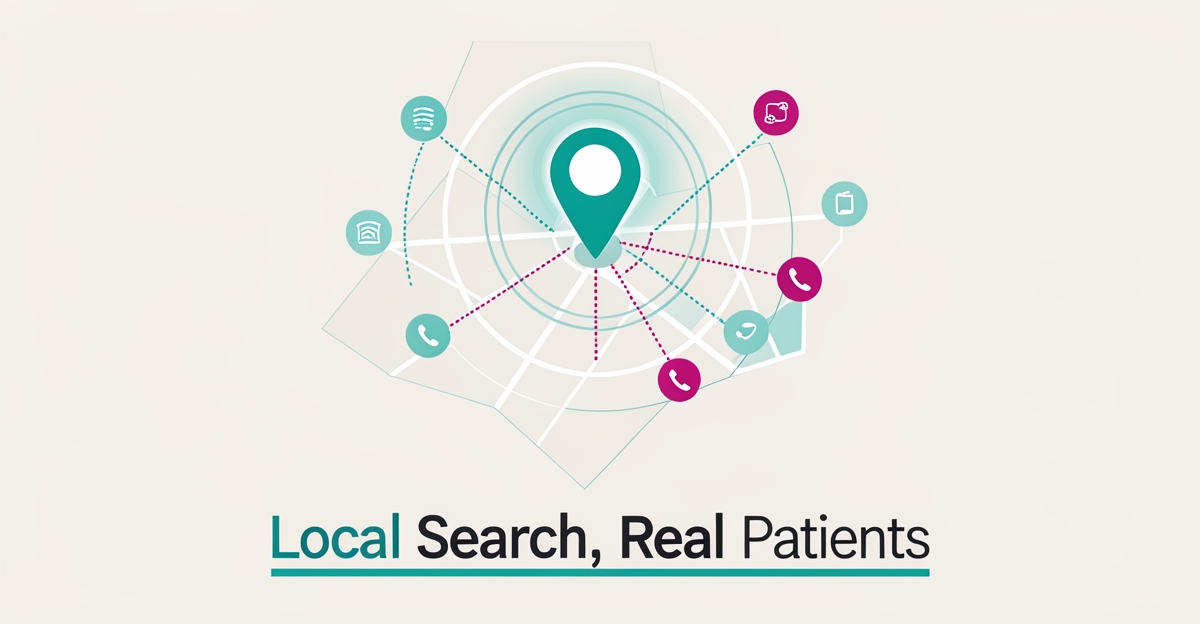
Key facts
- 77% of patients search online before booking an appointment, with 58% starting on Google according to Coalition Technologies.
- Nearly 70% of doctor searches are location-specific, emphasizing the need for precise service area visibility as noted by Galen System.
- Consistent NAP (Name, Address, Phone Number) across all platforms is critical for local SEO, down to the last comma advised by Simplified SEO Consulting.
- 89% of patients use Google before choosing a doctor, highlighting the importance of a strong Google Business Profile per Galen System.
- Google Maps has over 2 billion monthly users, influencing how patients find local healthcare as reported by AP News.
- 1-2 new patients per month can provide a significant positive ROI for SEO investments according to Galen System.
- Local SEO is a marathon, not a sprint, requiring sustained effort rather than one-time fixes emphasized by Simplified SEO Consulting
WANT RESULTS LIKE THIS?
Imagine a system doing all of this for your local business — every day, without you.
We build local businesses a custom website with a team of AI behind it: every lead captured and followed up, new content published monthly,customers finding you on Google — live in 7 days.
- 85+ pages at launch
- Every lead followed up, automatically
- Your whole business on one screen
Why Most Integrative Medicine Practices Lose Patients Before They Call
Most practices treat their website and Google Business Profile (GBP) as two separate pieces of marketing collateral—when patients see them as one seamless experience. That’s a costly blind spot. 77% of patients search online before booking an appointment, and 58% go straight to Google to find care near them. Yet while patients scroll, call, and compare, many practices leave their GBP dormant after setup: outdated hours, missing services, or no recent posts. That neglect sends a ripple effect—patients assume the entire practice is overlooked, and one in three won’t even click through to the website if the profile feels stale.
The problem compounds when location pages are thin or generic, or when the clinic’s name, address, and phone number don’t match exactly across every directory. Citations must be “exact matches… down to the last comma and abbreviation”—yet 60% of integrative medicine sites fail this basic check. When a clinic’s address appears as “123 Main St” in one place and “123 Main Street #100” in another, search engines get confused, and patients land on a competitor instead.
It’s not just about visibility—it’s about trust. Nearly 70% of doctor searches are location-specific, meaning a patient in Denver searching for acupuncture won’t settle for a Boulder result. If your GBP doesn’t clearly define your service radius or your website lacks dedicated pages for each neighborhood you serve, Google can’t match your expertise to that intent. The result? Fewer calls, fewer bookings, and a cycle of missed opportunities.
- Stale GBPs erode patient confidence before they even visit your site.
- Inconsistent NAP data across directories confuses search engines and drops you in rankings.
- Thin or missing location pages fail to signal to Google that you’re the right choice for patients in specific areas.
A neglected online presence isn’t just an aesthetic issue—it’s a conversion killer. Patients who can’t quickly confirm your services, location, or availability assume you’re not a reliable option. That assumption becomes reality when your phone stays quiet.
The GBP + Website System: How Discovery and Depth Work Together
Most integrative medicine practices treat their Google Business Profile and website as separate checkboxes — one for Maps, one for credibility. But research shows they function as a single discovery engine: GBP puts your clinic on the map for local searches, while your website provides the depth Google needs to match specific services to patient intent. Healthcare SEO specialists describe this as a unified system where "your Google Business Profile is what puts your clinic on the map (literally) for local searches. Your website provides the depth Google needs to understand what you do and which patients to match you with."
The numbers make the case plain. 89% of patients use Google before choosing a doctor, and nearly 70% of those searches are location-specific. When someone searches "IV therapy near me" or "functional medicine in Denver," Google cross-references your GBP categories, your website's service pages, and your review signals to decide who appears. If your GBP lists "Integrative Medicine Practitioner" but your website lumps every service onto one generic page, you've given Google relevance without depth — and depth without discovery.
AI search has only amplified this dependency. ChatGPT, Perplexity, and Google AI Overviews now recommend nearby care using the exact same GBP and website signals. Local SEO experts note that structured data and clear service definitions have become "more critical" as these systems parse your digital footprint for trustworthy answers. Integrative medicine's hybrid model — blending conventional, functional, and alternative modalities — demands a keyword strategy tailored to each specialty, not generic medical SEO advice. A dentist needs procedure-specific pages; a med spa needs trust signals. An integrative practice needs both, mapped to the actual service areas where patients are searching.
- GBP handles discovery — categories, hours, reviews, and map placement
- Website delivers depth — location-specific service pages, provider bios, FAQs, and booking paths
- Both must share identical NAP data down to the last comma and abbreviation
- AI search layers on top, reading the same signals for conversational recommendations
AI Business Sites builds this system from launch: hand-built core pages structured around your real services and service areas, GBP optimization included in setup, and an AI content engine that publishes new location-specific pages monthly — each automatically linked to strengthen the topical clusters Google rewards. The website doesn't just sit there. It feeds the discovery engine every week.
5 Proven Ways to Display Service Areas That Convert Geographic Interest Into Calls
Many patients searching for integrative medicine services start with a simple geographic query — they want to know if you’re nearby and what specific treatments you offer in their area. Turning that local interest into an actual appointment requires more than just listing your cities served; it demands a strategic, location-first approach that aligns with how patients actually search and decide. Research shows that nearly 70% of doctor searches are location-specific, making precise service area visibility a critical conversion factor.
To convert geographic interest into calls, integrative medicine practices should implement seven proven tactics grounded in local SEO best practices. First, create dedicated location-specific service pages for every core service and area combination — such as "IV Therapy in Salt Lake City" — so Google clearly understands which searches your clinic should rank for. Second, optimize your Google Business Profile with accurate categories, detailed service listings, and consistent 15-minute weekly updates to keep the profile active and authoritative. Third, maintain exact NAP consistency across every platform, down to the last comma, to avoid confusing search engines and weakening local signals.
Fourth, embed interactive maps on location pages that provide hyper-local directions, lane-level guidance, and real-time traffic advisories — features patients increasingly expect from AI-powered maps. Fifth, systematically generate and respond to reviews to strengthen your prominence signal, a key factor in Google’s local ranking algorithm. Sixth, implement schema markup for multi-location service architecture to help search engines parse your service areas and offerings accurately. Finally, monitor Waze for construction or hazard advisories near your clinics and update your Google Business Profile in real time to prevent patient frustration from outdated routing.
Each of these tactics transforms passive visibility into active patient engagement by meeting users where they search — with precise, trustworthy, and actionable location information. AI Business Sites supports this approach through automated location page generation, GBP optimization, and AI-driven content engines that ground every page in your actual services and service areas, ensuring your website doesn’t just exist — it works to convert local interest into booked appointments.
Local business: doing this the old way?
One system replaces the whole pile.
All of it — the website, the follow-up, the content, the leads — built and run for you for $1,497 + $497/mo. Month-to-month, and you own everything.
See what your build includesWhat AI-Driven Maps Mean for Your Practice — And What's Still Unproven
Google Maps is quietly rewiring how patients find local healthcare — but the AI layer still comes with sharp warning labels. With over 2 billion monthly users, Google’s Maps now integrates Gemini AI to suggest nearby destinations based on conversational queries, while third-party developers can tap the same language models to build healthcare-specific tools that answer questions like, “Does this clinic offer IV therapy?” Behind these features is a promise: smarter, faster, more intuitive local discovery. Yet for integrative medicine practices, the technology remains unproven when it comes to converting geographic interest into patient calls.
Research shows Google Maps is now the primary discovery channel for local healthcare, with 77% of patients searching online before booking and 58% starting specifically on Google. Nearly 70% of doctor searches are location-specific, making accurate service area display the difference between a missed call and a booked appointment. Google itself acknowledges the stakes, ranking businesses on Relevance, Proximity, and Prominence — a nearby practice can still rank poorly if competitors have stronger signals. The proven foundation remains exact NAP consistency across every platform, detailed location pages tied to core services, and optimized Google Business Profiles that act as the “digital front door.”
What’s new is the AI overlay. Google Maps’ Gemini integration is rolling out U.S.-only features like lane-level guidance and AI-generated summaries of nearby places, while MapZot.AI uses over 900 variables per site with 85–90% forecast accuracy for healthcare expansion planning. These tools offer exciting potential for patient routing, but no source provides direct evidence that AI-driven maps displayed on practice websites increase patient call rates. The risks are real: earlier AI systems have produced glaring errors, like suggesting glue on pizza or misstating presidential facts — mistakes that could misdirect patients to the wrong location or service. Healthcare practices must prioritize verified AI integrations and grounded responses to avoid misleading directions or false promises.
- Proven: Google Maps (2B+ users) and Google Business Profile optimization remain the top drivers of local discovery and patient calls.
- Emerging: AI-driven maps and location intelligence tools (like MapZot.AI’s 900-variable expansion planning) will shape future expectations but aren’t yet validated for direct call conversion.
- Critical risk: AI hallucinations in healthcare contexts can mislead patients about services, locations, or capabilities — verified integrations and manual review safeguards are essential.
AI Business Sites bridges current best practices with where patient expectations are heading. Our platform automates the creation of location-specific service pages, ensures NAP consistency across directories, and builds optimized Google Business Profiles from launch — while giving practices control over any AI-generated content through human-in-the-loop review. The result isn’t theoretical convenience; it’s a website that answers patient questions, matches their intent, and turns geographic interest into real appointments — today, and as AI features evolve.
Your 30-Day Plan to Fix Service Area Visibility and Start Getting Calls
Improving your integrative medicine service area visibility doesn't have to be a lengthy, mysterious process. With a focused, 30-day plan, you can significantly enhance your online presence and start attracting more patient calls. Below is a prioritized, week-by-week strategy grounded in proven local SEO research.
- GBP Categories & Details: Ensure your Google Business Profile (GBP) is categorized correctly as an "Integrative Medicine Practitioner" with all relevant secondary categories. According to specialized SEO research, this precise categorization is crucial for discovery.
- NAP Consistency: Audit and correct your Name, Address, and Phone Number (NAP) across all platforms to match your GBP exactly, "down to the last comma" as advised by SEO experts.
-
Citation Accuracy: Verify citations on key directories (WebMD, Healthgrades, Yelp, etc.) for consistency with your GBP.
-
Location-Specific Service Pages: Create dedicated pages for each "[Service] in [City/Neighborhood]" combination (e.g., "Acupuncture in Downtown Denver"). Each page should include service descriptions, provider bios, FAQs, and an embedded Google Map with detailed directions.
-
Embed Interactive Maps: Use Google Maps on each location page, highlighting parking, accessibility, and turn-by-turn directions to enhance user experience, aligning with Google's evolving map features.
-
Review Automation & Response: Implement a system to automatically request reviews post-visit and respond to all reviews within 48 hours, as emphasized by healthcare SEO experts.
- Google Posts Cadence: Maintain a weekly Google Posts update schedule with new content, photos, or updates to keep your GBP active.
-
Waze Claim & Updates: Claim your Waze listing and update it with real-time traffic advisories to manage patient expectations.
-
Track Map Rankings: Monitor your Google Maps rankings for target service-area keywords.
- Call Volume Analysis: Use your phone system or AI Voice Agent (like those integrated with AI Business Sites) to track and analyze call volumes.
-
Review Velocity & Sentiment: Analyze review growth and sentiment to identify areas for improvement.
-
Timeline for Traction: Expect a few months for these efforts to fully gain traction, as local SEO is "a marathon, not a sprint" according to experts.
- ROI Expectation: Even 1-2 new patients per month can provide a significant positive ROI on your SEO investments as highlighted in medical SEO research.
By following this structured 30-day plan, integrative medicine practices can lay a strong foundation for improved service area visibility, leading to increased patient calls and a stronger online presence.
Frequently Asked Questions
Why do some integrative medicine practices get fewer calls even when they're listed online?
How does Google decide which integrative medicine practice to show for location-specific searches?
What’s the best way to show patients I serve their specific neighborhood?
Do I really need to match my address and phone everywhere exactly?
Can AI-driven maps on my website actually get me more patient calls?
How often should I update my Google Business Profile to keep patients engaged?
Your Service Areas Aren't Just Locations — They're Your Next Patient Pipeline
The gap between a patient searching for "acupuncture near me" and actually calling your clinic isn't luck — it's whether your digital presence answers three questions instantly: Are you nearby? Do you offer what I need? Can I trust you? This article walked through the system that makes that happen: a Google Business Profile optimized for discovery, location-specific service pages built for depth, NAP consistency that eliminates confusion, interactive maps that remove friction, and review signals that build authority. Together, they turn geographic intent into booked appointments. The data is clear — nearly 70% of doctor searches are location-specific, and practices that treat their GBP and website as one unified system capture those patients while competitors stay invisible. AI Business Sites builds this system from day one: hand-built core pages structured around your real services and service areas, GBP optimization included in setup, and an AI content engine that publishes new location-specific pages monthly — each automatically linked to strengthen the topical clusters Google rewards. Your website doesn't just sit there. It feeds the discovery engine every week. Ready to stop losing patients before they call? Let's build a website that works as hard as you do.
FOR local businesss — BUILT AND RUN BY US
Your website. Your content. Your leads. Your data.
$500 starts your build. Seven days later it's live — chat, booking, follow-up, and your Google presence all set up. Then we run it, every month. You do the work you actually get paid for.