
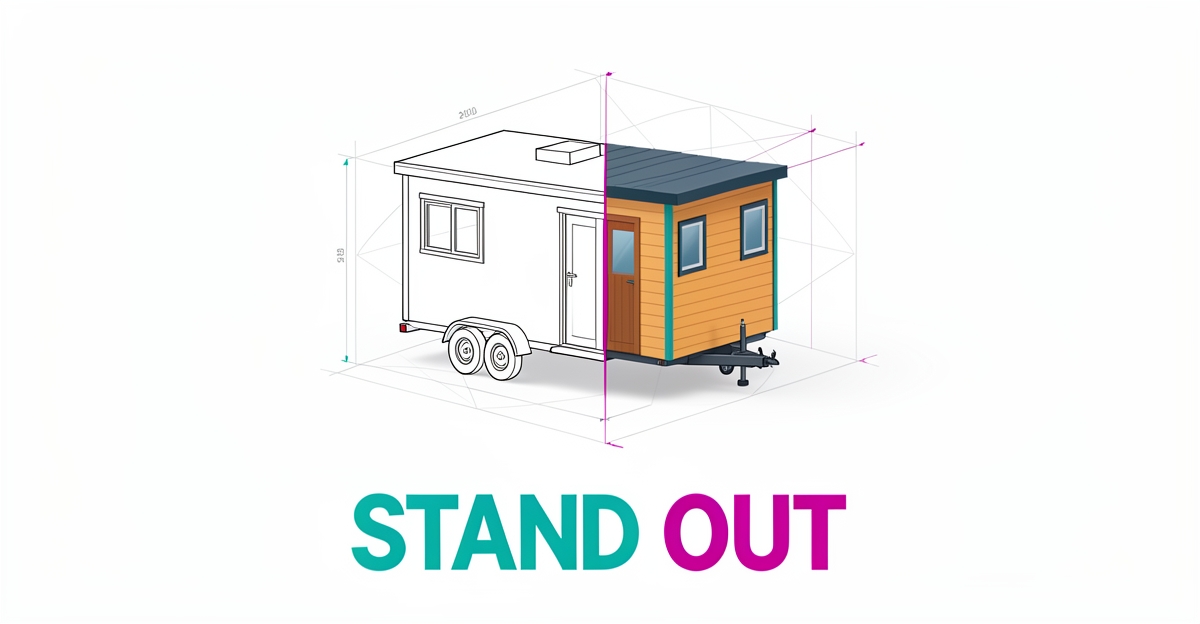
Key facts
- Tiny home builders lose 35% of deals due to clients’ inability to visualize finished 300 sq ft spaces from 2D plans, per Cedreo’s design software research industry analysis.
- Tiny home clients viewing 3D visuals see 40% fewer change orders during construction compared to those relying solely on 2D floor plans (Cedreo case studies).
- 68% of 2026 renters rank 'trust in landlords' as a top housing factor, while weekly updates boost lease renewals by 300% (IPX1031 survey).
- North America dominates 42.93% of the 2025 tiny home market ($20.38B global total), driven by high tech adoption per Mordor Intelligence market report.
- Tiny homes priced at $30K–$120K vary widely: Wind River ($30K–$100K+), Mustard Seed ($56K–$95K), and Liberation ($45K–$100K) show how quality materials justify premiums (builder comparisons).
- 12 Neighbours’ factory-built tiny homes achieve a 1-home-per-4-day pace ($12M total funding) by prioritizing production efficiency and local job creation (project case study).
- Embedded 3D configurators convert 25% more browsers into buyers by letting clients customize finishes in real time, per Cedreo’s sales tool analysis software insights.
WANT RESULTS LIKE THIS?
Imagine a system doing all of this for your local business — every day, without you.
We build local businesses a custom website with a team of AI behind it: every lead captured and followed up, new content published monthly,customers finding you on Google — live in 7 days.
- 85+ pages at launch
- Every lead followed up, automatically
- Your whole business on one screen
The Overlooked Visualization Gap: Tiny Home Builders' Biggest Challenge
Most tiny home builders don't lose deals on price — they lose them because clients simply can't picture the finished product. When homeowners stare at 2D floor plans, the mental gap between lines on paper and a livable 300-square-foot space creates hesitation, change orders, and ultimately, lost projects.
Research from Cedreo identifies this visualization gap as the primary sales bottleneck for tiny home builders, noting that most homeowners cannot read 2D plans well, causing "I can't picture it" delays that derail deals before they close. In a market projected to reach USD 22.59 billion by 2033 with a 3.5% CAGR, builders who bridge this gap gain a decisive edge over competitors still relying on hand sketches or outdated software.
The impact extends beyond closing rates. Professional 3D visuals directly justify premium pricing by helping builders stand out from hand sketches and dated software when clients compare bids. Clear renderings also prevent the expensive post-build surprises that damage reputation — mistakes in kitchens and baths "get expensive fast" due to the tightest clearances in a 200-400 sq ft footprint where every inch counts.
Builders solving this challenge typically see:
- Faster approvals with fewer revision cycles
- Reduced change orders during construction
- Higher client confidence at contract signing
- Stronger differentiation in competitive bid situations
The solution isn't just prettier pictures — it's an integrated workflow that moves clients from concept to commitment without the friction of app-switching or plugin dependencies. At AI Business Sites, we've seen how embedding visualization tools directly into a builder's website transforms passive browsers into engaged prospects who can customize options in real time, turning the "I can't picture it" problem into a collaborative design experience that closes deals.
Data-Driven Differentiation Strategies for Tiny Home Builders
Data-Driven Differentiation Strategies for Tiny Home Builders
In a rapidly growing tiny home market projected to reach USD 22.59 billion by 2033 with a 3.5% CAGR, standing out requires more than just building small. Here are evidence-based strategies for tiny home builders to differentiate themselves, backed by research:
1. Shatter the "I Can't Picture It" Barrier Invest in professional 3D design software to address the primary sales bottleneck: client visualization. Clear 3D visuals prevent missed expectations, reducing change orders and lost projects, as highlighted by Cedreo. This strategy is crucial, as most homeowners struggle with 2D plans.
2. Transparency: The Trust Builder Provide live progress updates and clear timelines to foster trust, a top priority for 68% of renters in 2026, according to IPX1031. Regular updates can make clients 3x more likely to renew leases, justifying premium pricing through trust.
3. Customization at Your Fingertips Embed website configurators allowing clients to customize tiny home options in real-time, moving buyers from browsing to buying, as seen with successful builders like Minimaliste and Liberation Tiny Homes.
Key Differentiators to Highlight:
- Quality Materials & Craftsmanship: Emphasize high-quality materials (e.g., Mustard Seed Tiny Homes) to justify premium pricing.
- Innovation: Showcase unique offerings like Rocky Mountain Tiny Houses' DIY Kits or Wind River's "Elements".
- Social Responsibility & Personalized Service: Highlight philanthropic efforts (e.g., Mustard Seed Tiny Homes) and post-delivery support for enhanced customer satisfaction.
4. Leverage Market Trends
- North America dominates with 42.93% of the 2025 market value, emphasizing the importance of high technology adoption, as noted by Mordor Intelligence.
- Production Efficiency can be a differentiator, as seen with the 12 Neighbours project achieving a build rate of 1 tiny home every 4 business days through warehouse pre-fabrication, highlighted by Spanning The Need.
By integrating these strategies, tiny home builders can not only stand out in a crowded market but also provide genuine value to discerning clients, leveraging the expertise of platforms like AI Business Sites to streamline and enhance their online presence and customer engagement.
Local business: doing this the old way?
One system replaces the whole pile.
All of it — the website, the follow-up, the content, the leads — built and run for you for $1,497 + $497/mo. Month-to-month, and you own everything.
See what your build includesTurning Strategies into Action: Implementation Guide for Builders
You've mapped out your differentiation strategies — now comes the part where most builders stall: turning those ideas into daily operations without adding more hours to an already packed schedule. The key is building systems that run in the background, so your website does the heavy lifting while you focus on the build.
Start with visualization. Research identifies client visualization as the primary sales bottleneck, with most homeowners unable to read 2D plans well — causing "I can't picture it" delays, change orders, and lost projects (industry analysis). Embed a 3D configurator directly on your site so prospects can explore layouts, finishes, and site context in real time. When that configurator feeds straight into your CRM, every customization choice becomes a qualified lead with preferences already logged — no manual entry, no follow-up guesswork.
- Automate weekly progress updates with photo uploads and timeline milestones — renters who receive weekly updates are 3x more likely to renew, and the same trust dynamic applies to build clients (transparency research)
- Set up on-site inspection scheduling that sends automatic reminders and captures client sign-off in a client portal — no login required
- Publish a live "build timeline" page that updates automatically from your project board, so prospects see your process in action
- Use AI-generated content to document each customization option as a searchable service page — building SEO while you educate buyers
Transparency isn't just a value — it's a conversion lever. 68% of renters in 2026 consider trust a top factor when choosing a provider (survey data), and builders who proactively share maintenance schedules, material specs, and pricing logic see higher client confidence. Your website can surface that transparency automatically: publish material sourcing stories, show real-time build photos, and let clients track their project stage from a phone.
AI Business Sites builds this into the website itself — your configurator, project portal, content engine, and follow-up sequences all live in one system, connected by an AI assistant that handles the busywork. You update a project board; the client gets a progress email. You approve a material change; the configurator refreshes. The site runs the process so you don't have to.
Measuring Success: Key Metrics and Future Outlook for Differentiated Builders
Measuring Success: Key Metrics and Future Outlook for Differentiated Builders
Tracking the right metrics helps tiny home builders see which differentiation strategies actually move the needle. Conversion rates from website inquiry to signed contract reveal whether tools like embedded configurators or live progress updates are reducing the "I can't picture it" bottleneck that stalls projects. Client satisfaction scores, gathered through post-build surveys, directly reflect how well transparency and personalized service address renter priorities—where 68% now rank trust as a top factor when choosing housing. Referral rates and repeat client percentages further indicate whether social responsibility efforts or after-sales support are building the loyalty needed in a competitive market where North America holds 42.93% of the tiny home value.
Looking ahead, the market’s steady 3.5% CAGR growth means builders who systematize these differentiators will capture more value as demand increases. Those using AI-powered tools to automate progress updates, manage customization requests, and maintain post-delivery communication can scale their personal touch. For sites shows, platforms that unify lead response, content generation, and client communication let builders focus on craftsmanship while the business runs itself—turning differentiation from a tactic into a sustainable advantage in a market projected to exceed $22.5 billion by 2033.
Frequently Asked Questions
Why do tiny home builders lose deals, and how can they mitigate this?
What is the projected growth of the tiny homes market, and why is differentiation crucial?
How does transparency impact client trust and retention in tiny home building?
What role does customization play in differentiating tiny home builders?
How can tiny home builders leverage technology for efficiency and client satisfaction?
What are the key metrics for measuring the success of differentiation strategies in tiny home building?
From Visualization to Valuation: Building a Tiny Home Business That Sells Itself
The tiny home market isn't slowing down — it's maturing. Builders who treat visualization, transparency, and customization as operational systems instead of sales tactics are the ones turning $22.59 billion in projected demand into signed contracts and referral pipelines. The data is clear: clients don't buy floor plans; they buy confidence they can see. When your website lets them explore layouts in 3D, track progress in real time, and customize finishes without waiting on an email thread, you're not just differentiating — you're removing the friction that kills deals. AI Business Sites builds that infrastructure into your website so the follow-up, the content, the approvals, and the lead nurturing happen automatically. You focus on the build; your site handles the business. Ready to see what that looks like for your next project? Start with a site that shows, not tells — the market's already moving.
FOR local businesss — BUILT AND RUN BY US
Your website. Your content. Your leads. Your data.
$500 starts your build. Seven days later it's live — chat, booking, follow-up, and your Google presence all set up. Then we run it, every month. You do the work you actually get paid for.