
Key facts
- Swim schools serve customers within 15–30 minutes drive or 25 miles according to local market research.
- FAQ pages can boost brand citations by 106% and People Also Ask rankings by 430% based on SEO performance data.
- AI chatbots can reduce customer service costs by up to 30% and handle up to 80% of routine questions according to industry insights.
- The global swim school market is projected to grow from $9–10 billion in 2024 to $17+ billion by 2033 based on franchise industry analysis.
- Door hangers cost just $0.35 per door with a 2% response rate, yielding $1,000+ lifetime value per customer according to local marketing case studies.
- Parents typically research 2–3 swim schools before deciding, making online trust signals and instant follow-ups critical based on industry conversion insights.
- Formal swim lessons can reduce childhood drowning likelihood by up to 88% according to public health data.
WANT RESULTS LIKE THIS?
Imagine a system doing all of this for your local business — every day, without you.
We build local businesses a custom website with a team of AI behind it: every lead captured and followed up, new content published monthly,customers finding you on Google — live in 7 days.
- 85+ pages at launch
- Every lead followed up, automatically
- Your whole business on one screen
The Hidden Red Flags Costing You Local Swim Lesson Bookings
Your swim school website might be quietly turning away local parents before they even consider booking a lesson. Despite strong demand in your area, subtle flaws in how your site presents information can erode trust and push families toward competitors who make the decision easier.
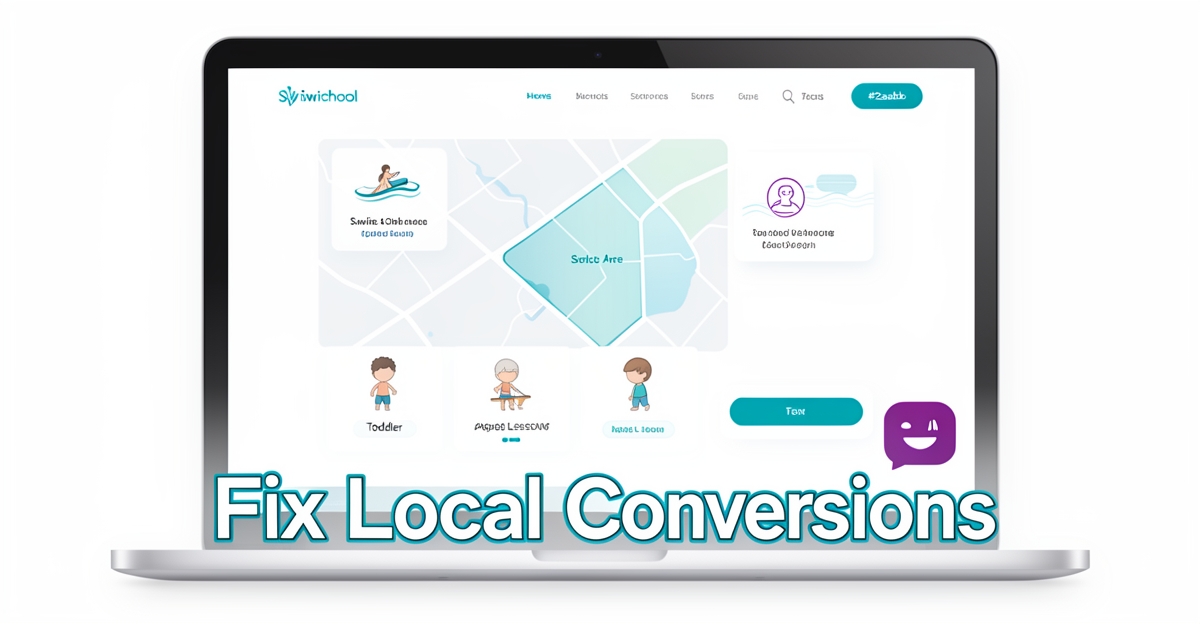
One of the most common red flags is missing or vague service area details. Since 80% of swim school customers live within a 15–30 minute drive of the facility, parents need to instantly see if you serve their neighborhood according to local market research. Yet many websites bury this information in footers or omit it entirely, forcing visitors to guess or leave. A clear "We Serve" section with zip codes, drive-time radii, and an embedded Google Map isn’t just helpful—it’s critical for local SEO and conversion.
Another frequent issue is a one-size-fits-all approach to lesson descriptions. Parents researching options for their 6-month-old versus their 8-year-old have vastly different concerns—safety, instructor ratios, and progression tracking vary by age. Sites that lack dedicated pages for infant, toddler, preschool, and school-age programs fail to answer the specific questions driving parental decisions. As noted in industry insights, strategic FAQ pages that address these nuances can boost brand citations by 106% and People Also Ask rankings by 430% based on SEO performance data.
Outdated design also silently kills conversions. If your site feels like it was built a decade ago—with slow load times, clunky navigation, or non-mobile-friendly layouts—parents will question your professionalism and safety standards. Modern families expect seamless online experiences, from checking schedules to booking trials. A website that looks neglected suggests the same might be true of your facility, especially when parents are comparing 2–3 options before deciding.
Other hidden barriers include missing social proof like recent reviews or testimonials, absent pricing transparency, and no clear path to book a trial lesson. Parents often need reassurance before committing, and without visible trust signals or easy next steps, they’ll move on—even if your lessons are excellent.
Fixing these issues starts with treating your website as a 24/7 enrollment tool. By clarifying your service area, building age-specific content, modernizing design, and integrating automated lead capture—like an AI assistant that answers questions and captures details instantly—you transform passive visitors into confident bookers. The goal isn’t just to look better online; it’s to make it effortless for local parents to choose you.
The Solution: Hyper-Local Website Optimization with AI-Driven Personalization
The most effective swim school websites don’t just list classes—they speak directly to local parents in their language, at their moment of need. By combining hyper-local content with intelligent automation, these sites turn casual visitors into enrolled families by answering questions before they’re even asked. Location-optimized pages that reference specific neighborhoods, zip codes, and drive times signal relevance to both search engines and nearby parents, addressing the critical gap where most swim schools fail to reflect their true service radius of 15–30 minutes or 25 miles. When paired with clear age-specific program details and embedded Google Maps showing service boundaries, this approach builds immediate trust and reduces bounce rates from families who assume the school is too far away.
AI-powered personalization takes this further by adapting the experience in real time. An AI assistant on the site can answer routine questions about schedules, pricing, or safety protocols using the school’s own knowledge base—handling up to 80% of common inquiries while reducing customer service costs by as much as 30%. This isn’t just about convenience; it’s about capturing leads outside business hours when parents are most likely to research options. Every interaction—whether through chat, form submission, or phone call—feeds into a unified system that triggers instant, personalized follow-up emails, ensuring no lead goes cold due to delayed response. Behind the scenes, visual automation workflows nurture prospects with targeted content: a welcome message, followed by safety philosophy, age-specific program highlights, parent testimonials, and a trial lesson offer—all timed to match the parent’s decision journey.
This closed-loop system transforms the website from a static brochure into an active lead engine. Businesses using similar AI-driven automation report closing the conversion gap that causes most swim schools to lose prospects who are actively comparing 2–3 options. By integrating location-aware content, intelligent chat support, and automated nurture sequences—all grounded in the school’s actual offerings and service area—swim schools can reclaim visibility in local search, reduce manual workload, and convert more nearby families without adding staff or complexity. The result is a website that doesn’t just exist—it works.
Local business: doing this the old way?
One system replaces the whole pile.
All of it — the website, the follow-up, the content, the leads — built and run for you for $1,497 + $497/mo. Month-to-month, and you own everything.
See what your build includesStep-by-Step Implementation to Attract and Retain Local Families
You've identified the gaps — now here's how to close them systematically.
Start with a service area audit. Most swim schools serve families within 15–30 minutes of the pool, yet few websites make that radius visible. List every neighborhood, zip code, and drive-time boundary on your homepage, footer, and lesson pages. Embed a Google Map showing your actual coverage. This single step aligns your site with how parents search — and how Google ranks local businesses.
Next, build age-specific lesson pages that answer the questions parents actually ask. A strategic FAQ structure drives a 106% increase in brand citations and a 430% jump in "People Also Ask" rankings. Create dedicated pages for infant, toddler, preschool, school-age, and adult programs — each with curriculum details, safety ratios, scheduling options, and parent-focused FAQs addressing fear of water, progression tracking, and make-up policies.
Then optimize your Google Business Profile as a core website extension, not an afterthought. Claim and verify your listing. Set accurate service areas (not just your address). Select "Swim School" as your primary category with relevant secondaries. Upload 20+ authentic photos of your pool, instructors, and lessons. Post weekly updates — schedule changes, safety tips, community events. Implement systematic review requests after milestone lessons.
- Audit service areas and embed location signals on every key page
- Build age-specific pages with parent-decision FAQs
- Optimize GBP with photos, posts, and review automation
- Deploy instant lead capture with AI-powered follow-up sequences
- Modernize design for mobile-first trust and speed
Finally, connect every lead source — forms, chat, phone, booking — to a single system that responds instantly. Most businesses lose leads simply by being slow to reply. An AI assistant that answers questions using your actual knowledge base (schedules, pricing, policies) and captures lead info 24/7 closes that gap before it opens. Pair this with a 5-email nurture sequence: welcome → safety philosophy → age-specific program → parent testimonial → trial lesson offer.
Frequently Asked Questions
How far do parents typically travel to get to swim lessons?
Why do I need separate pages for infant vs. school-age swim lessons?
What happens if my website looks outdated or slow?
Is having a Google Business Profile really that important for a swim school?
How can I make sure parents actually book a trial lesson after visiting my site?
Do I really need to display pricing on my website?
Key Takeaways
{ "title": "Transform Your Swim School’s Digital Footprint for Lasting Impact", "content": "Your swim school’s website is more than just an online presence—it’s a gateway to trust, convenience, and ultimately, booked lessons. By addressing the 7 hidden red flags outlined, you’re not just fixing flaw
FOR local businesss — BUILT AND RUN BY US
Your website. Your content. Your leads. Your data.
$500 starts your build. Seven days later it's live — chat, booking, follow-up, and your Google presence all set up. Then we run it, every month. You do the work you actually get paid for.