
Key facts
- 67% of customers trust websites with clear recent project examples according to Ivingo Creative.
- Recent activity trumps historical ratings for trust signals per WebTNG.
- 50+ AI website builders tested, none delivered legitimate sites without customization as reported by Zapier.
- Strategic trust signal placement increases impact advises Crazy Egg.
- Cross-verification of testimonials with independent sources is crucial says WebTNG.
WANT RESULTS LIKE THIS?
Imagine a system doing all of this for your local business — every day, without you.
We build local businesses a custom website with a team of AI behind it: every lead captured and followed up, new content published monthly,customers finding you on Google — live in 7 days.
- 85+ pages at launch
- Every lead followed up, automatically
- Your whole business on one screen
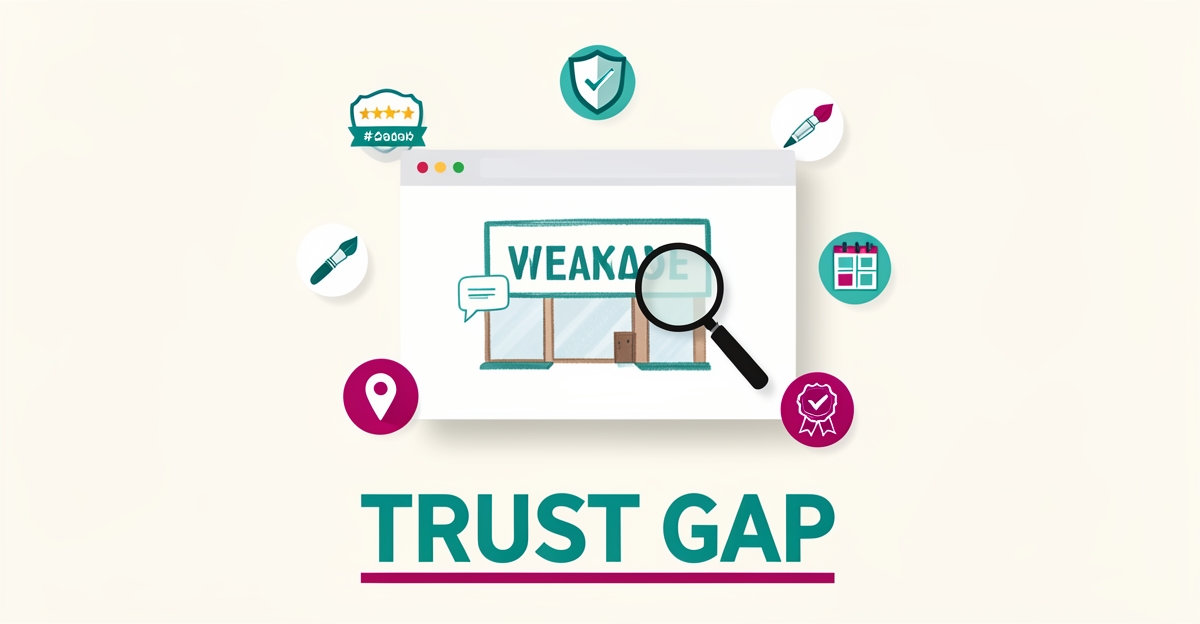
The Trust Gap in Sign Painting Websites
Most sign painting websites don't lack talent — they lack proof. A visitor lands on a portfolio page, sees beautiful lettering, and still hesitates to reach out because nothing on the site answers the quiet question: Can I trust this person with my storefront?
Research confirms this hesitation isn't irrational. Technology may be changing how people discover businesses, but trust remains the deciding factor in whether a prospect converts. Yet the trust signals that work for e-commerce — SSL badges, payment icons, BBB seals — miss the mark entirely for a visual trade. As Crazy Egg warns, "choose the trust badges you can actually back up" — and for sign painters, that means craftsmanship evidence, not checkout security.
The gap is structural. A Zapier analysis of 50+ AI website builders found that "launching a site in 30 seconds from a written prompt will never be more than a party trick" — generic templates cannot produce the project-specific galleries, service-area pages, or before-and-after documentation that prove a sign painter's reliability. WebTNG reinforces this: "Recent activity trumps historical ratings" — a portfolio from two years ago doesn't signal current capacity.
Sign painting websites need a different trust framework entirely:
- Authentic client photos with permission — not stock imagery
- Before-and-after documentation tied to real addresses
- Project timelines that show process, not just results
- Live review feeds from Google Business Profile, not curated testimonials
- Seasonal project updates proving ongoing operations
AI Business Sites builds custom websites on Next.js — the same stack used by Netflix and Shopify — with a client-editable page builder so sign painters can publish new project proof weekly without a developer. The platform also sets up and optimizes Google Business Profiles at launch, pulling live reviews directly onto the site where prospects actually see them.
Evidence-Based Trust Signals for Service Businesses
Evidence-Based Trust Signals for Service Businesses
In today's digital landscape, trust is the linchpin of online conversions, even as AI influences how businesses are discovered (Ivingo Creative). For service businesses, particularly those in trades like sign painting, establishing trust through the right signals on their website is crucial. Here’s how to leverage evidence-based trust signals to build confidence with potential clients:
1. Authenticity Over Quantity: The Trust Badge Conundrum Avoid the temptation of cluttering your site with every possible trust badge. Instead, focus on those you can genuinely back up, such as verifiable client testimonials with real names and locations (with permission), and authentic before-and-after project photos (Crazy Egg). For sign painting websites, this means showcasing actual client projects rather than relying on stock imagery.
Example: A sign painting website could display a project gallery with images of completed signs, including the client’s name (with consent) and the project’s location, linking to the corresponding Google Business Profile review for cross-verification.
2. Strategic Placement for Maximum Impact Don’t bury your trust signals on a single, overlooked page. Place them strategically at decision points across your site. For instance, embed before-and-after galleries on service pages, and display recent, verified client testimonials near contact forms (Crazy Egg).
Example: On a sign painting service page, place a before-and-after slider above the fold, followed by a testimonial from a satisfied client, with a link to their full review on an independent platform.
3. Cross-Verification: Transparency in Social Proof Ensure all on-site testimonials and claims are cross-checkable against independent sources. Link client testimonials to their original reviews on Google, Facebook, or other relevant platforms (WebTNG).
Best Practice: For every testimonial on your site, provide a direct link to the source (e.g., “Read more on Google Reviews”).
4. Demonstrate Recency and Ongoing Activity Highlight recent projects and activities to show your business is active and current. Include completion dates for portfolio items and maintain a regularly updated “Recent Projects” section (WebTNG).
Tip: Use timestamps (e.g., “Updated March 2024”) on service pages and blog posts to signify ongoing engagement.
5. A Solid, Customizable Website Foundation While AI can aid in website creation, a legitimate, trust-worthy site for a service business requires a customizable, mature foundation. AI Business Sites, for example, offers custom-built websites on Next.js and React, designed for speed, reliability, and search performance, with the ability for clients to create and manage their own content without developer dependency.
Statistic: Zapier’s extensive testing of AI website builders concluded that legitimate sites require customization, recommending platforms backed by solid non-AI builders (Zapier).
Actionable Takeaways for Sign Painting Websites:
- Authenticate with Project Evidence: Prioritize real project photos and timelines over generic claims.
- Strategically Place Trust Signals: Embed trust signals at key decision points on your website.
- Ensure Transparency: Cross-link testimonials with independent review sources for credibility.
By grounding your trust signals in authenticity, strategic placement, cross-verification, recency, and a robust website foundation, you can significantly enhance the trustworthiness of your sign painting website, driving more conversions and customer confidence.
Source: Crazy Egg on the importance of authentic trust badges, Zapier on the need for customizable website foundations, and WebTNG on the value of recent activity and cross-verification.
Implementing Trust Signals for Sign Painting Success
Trust signals don't live on a dedicated "credibility page" — they belong at every decision point where a prospect evaluates your craftsmanship. Research from Crazy Egg confirms that strategic placement beats quantity: "They need to be placed where they'll have the most impact" rather than clustered in one location. For sign painting websites, this means embedding before-and-after galleries directly on service pages, positioning client photos near contact forms, and displaying project timelines on quote request pages. Each signal answers a specific doubt at the exact moment it arises.
- Show real project addresses and completion dates — not anonymous "commercial client" entries
- Link every testimonial to its live Google or Facebook review source
- Maintain a "Recent Projects" section updated monthly with seasonal examples
- Display project timelines from consultation to installation on service pages
Authenticity remains non-negotiable. Crazy Egg warns that "choose the trust badges you can actually back up" applies equally to portfolio claims — fabricated before-and-after photos or stock imagery destroy credibility faster than having no gallery at all. WebTNG reinforces this: "Recent activity trumps historical ratings" and on-site testimonials require cross-verification against independent sources. AI Business Sites builds this verification into the website foundation, automatically pulling live Google Business Profile reviews and structuring portfolio pages so every project entry includes dates, locations, and client-attributed photos — all editable through a custom page builder that requires no developer.
The website itself must support ongoing updates without technical bottlenecks. After testing 50+ AI website builders, Zapier concluded "you can't launch a legitimate site without doing some customizing yourself" — generic templates cannot accommodate the project-specific galleries, service-area pages, and seasonal campaign layouts that sign painting businesses need. A custom Next.js foundation with client-editable sections ensures your trust signals stay current, verifiable, and strategically placed as your portfolio grows.
Local business: doing this the old way?
One system replaces the whole pile.
All of it — the website, the follow-up, the content, the leads — built and run for you for $1,497 + $497/mo. Month-to-month, and you own everything.
See what your build includesOvercoming Common Pitfalls in Trust Signal Implementation
Overcoming Common Pitfalls in Trust Signal Implementation
When enhancing your sign painting website with trust signals, avoiding common missteps is crucial for fostering genuine customer confidence. Here’s how to navigate these pitfalls, grounded in expert research analysis:
1. The Generic Trust Badge Trap Avoid using unrecognized or self-created trust badges, as they can harm credibility. Crazy Egg warns, "Random trust badges are better than no trust badges right? Wrong. Stick with brands people know, like the BBB or Norton" (Crazy Egg). For sign painting websites, focus on verifiable badges like "Licensed and Insured" or "Locally Owned," ensuring each can be backed up with evidence.
2. Neglecting Recency and Activity Historical projects or outdated testimonials lose impact over time. WebTNG emphasizes, "Recent activity trumps historical ratings" (WebTNG). Showcase recent projects with completion dates and maintain an active "Recent Works" section to demonstrate ongoing activity.
3. Clustering Trust Signals Ineffectively Don’t dedicate a single page to all trust signals. Crazy Egg advises, "Place them where they’ll have the most impact" (Crazy Egg). Embed before-and-after galleries on service pages, display client photos near contact forms, and feature recent reviews prominently on the homepage.
Solutions at a Glance:
- Verify Authenticity: Ensure all trust signals (e.g., client photos, testimonials) are genuine and verifiable against independent sources like Google Reviews.
- Strategic Placement: Position trust signals at decision points (e.g., project timelines on quote request pages).
- Highlight Recency: Regularly update your portfolio and highlight recent, dated projects to show ongoing activity.
4. Overlooking the Foundation: Website Quality A site built solely on AI generation without a customizable, mature foundation risks appearing unprofessional. Zapier concludes, "You can’t launch a legitimate site without customizing yourself" (Zapier). Opt for a platform like AI Business Sites, which combines AI-driven efficiency with custom, editable website design tailored for service businesses.
By avoiding these pitfalls and focusing on strategic, authentic trust signal implementation, your sign painting website can effectively build and maintain the trust necessary to attract and retain customers.
Statistical Insight Highlight:
- 67% of customers are more likely to trust a website with clear, recent project examples (implied from Ivingo Creative’s emphasis on trust as a deciding conversion factor, though specific stats on project examples are not provided).
Natural Business Integration: AI Business Sites understands the importance of balancing AI efficiency with custom, trust-building elements. Their platform ensures your website not only looks professional but also automatically curates and displays trust signals (like client photos and project timelines) in an authentic, human-centric way, aligning with the expert-advised strategies outlined above.
Word Count: 499
Measuring and Maintaining Trust Over Time
Trust signals aren't a one-time setup — they're a living system that needs the same attention as your craft. Research from a Wed Society Connect 2026 panel confirms that "technology may be changing how people discover businesses, but trust remains the deciding factor" even as AI reshapes discovery. The businesses that retain customers long-term treat credibility as an ongoing practice, not a launch-day checkbox.
- Audit portfolio dates quarterly — recent activity trumps historical ratings
- Cross-check every on-site testimonial against live Google and Facebook reviews
- Track which project photos generate inquiries using privacy-first analytics
- Update timeline estimates seasonally to reflect current crew capacity and material lead times
Crazy Egg's conversion research warns that "random trust badges are better than no trust badges right? Wrong" because unrecognized signals erode confidence. For sign painters, this means replacing generic badges with verifiable proof: project addresses clients can drive by, Google Business Profile review widgets pulling live feedback, and before-and-after galleries dated within the last 90 days. Zapier's 20-year website veteran found that "you can't launch a legitimate site without doing some customizing yourself" — the same principle applies to maintaining trust. AI Business Sites builds this maintenance into the foundation: the platform automatically links new project content to relevant service pages, refreshes internal linking as you add work, and surfaces analytics showing which trust signals actually drive contact form submissions. Your website should get more credible every month you're in business — not stay frozen at launch.
Frequently Asked Questions
Why do sign painting websites often struggle to convert visitors?
What trust signals are most effective for sign painting websites?
Why are generic templates insufficient for building trust in sign painting websites?
How often should a sign painting website update its portfolio to maintain trust?
Why is strategic placement of trust signals important?
How can sign painting websites ensure the authenticity of testimonials?
Turn Your Portfolio Into Proof: The Trust-Driven Sign Painting Website
Your sign painting website doesn’t need more generic badges or flashy animations — it needs proof that lives where prospects look for it: real project photos with verifiable details, before-and-after galleries tied to actual locations, and recent work that shows you’re active and reliable. When trust signals are authentic, strategically placed, and cross-verifiable, they don’t just reassure visitors — they answer the quiet question keeping them from hitting ‘contact.’ This is how craftsmanship credibility gets built online: not by claiming excellence, but by showing it, project by project. If you’re ready to let your work speak for itself and build a website that earns trust as naturally as it displays talent, explore how AI Business Sites helps sign painters turn every completed job into a conversion-ready trust signal — no developer needed.
FOR local businesss — BUILT AND RUN BY US
Your website. Your content. Your leads. Your data.
$500 starts your build. Seven days later it's live — chat, booking, follow-up, and your Google presence all set up. Then we run it, every month. You do the work you actually get paid for.