
Key facts
- Only 4.4% of physical therapy businesses use AI for operational tasks according to Evidence in Motion.
- Medicare Advantage covers over 50% of Medicare-eligible patients, squeezing practice margins as noted by Evidence in Motion.
- Slow lead follow-up costs PT clinics patients; same-day automated outreach is now baseline per Second Door.
- 67% of businesses fail to prioritize form placement and responsiveness highlighted by Second Door.
- AI won't fix a broken PT front office—it amplifies existing processes warns Scott Hebert, CEO of Second Door.
- PT practice growth depends on operational clarity before AI adoption cited by Zach Walston of Second Door.
- Over 50% of Medicare-eligible patients are on Medicare Advantage with reimbursement rates ~70% of the fee schedule reported by Evidence in Motion.
WANT RESULTS LIKE THIS?
Imagine a system doing all of this for your local business — every day, without you.
We build local businesses a custom website with a team of AI behind it: every lead captured and followed up, new content published monthly,customers finding you on Google — live in 7 days.
- 85+ pages at launch
- Every lead followed up, automatically
- Your whole business on one screen
The Real Reason Your Website Isn't Booking Patients
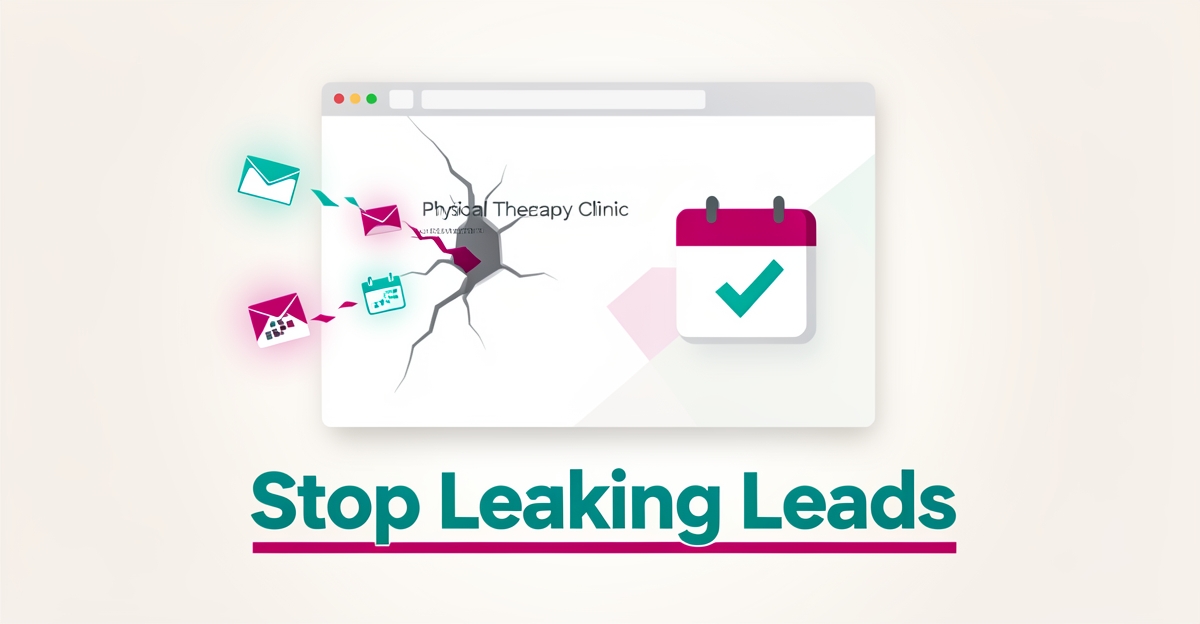
Most clinic owners stare at their analytics wondering why traffic doesn't turn into booked evaluations. The uncomfortable truth, backed by PT industry leaders, is that website conversion failures are rarely about the website itself — they stem from broken front-office operations and slow lead follow-up.
Scott Hebert, PT, DPT, CEO and Co-Founder at Second Door, puts it bluntly: "AI won't fix a broken PT front office — it'll just move faster through the chaos. Fix your operations first, then automate." Zach Walston, PT, DPT, Head of Clinical at Second Door, reinforces this with data from Prompt's 2026 Rehab Therapy Report: "PT practice growth depends on operational clarity first — AI only works when the workflow beneath it is clean."
Speed-to-lead is the single biggest conversion lever. Doug Houvener, Head of Marketing at Second Door, identifies the baseline: "Slow lead follow-up costs PT clinics patients. Learn why same-day automated outreach is now the baseline for converting inquiries into appointments." Yet business AI adoption for producing goods and services sits at only 4.4%, and most clinics still rely on manual callbacks that take hours or days.
Dr. Larry Benz, Executive Chairman of Confluent Health, predicts a "Patient-Centric Work Shift" where scheduling, payments, and paperwork transfer to patients — but the industry isn't there yet. Medicare Advantage now covers over 50% of Medicare-eligible patients with reimbursement rates around 70% of the fee schedule, squeezing margins and making every lost lead more expensive.
The seven signs we'll cover — invisible contact forms, vague service descriptions, missing instant booking, no automated follow-up, and others — are not standalone UX problems. They're symptoms of a deeper operational gap: a front door that doesn't connect to a functioning front office.
- No instant, personalized auto-response when a lead submits a form
- Booking requires a phone callback instead of a direct link
- Lead ownership is unclear — nobody knows who follows up
- Service pages don't answer the specific questions patients search for
- No system to re-engage leads who don't book on the first visit
AI Business Sites builds websites that close this gap by design — every lead triggers an immediate response, booking links live on service pages, and the AI assistant qualifies and routes inquiries before your team ever opens their inbox. The website isn't the product; the working front office behind it is.
Signs Your Lead Capture Is Leaking Patients
Signs Your Lead Capture Is Leaking Patients: Friction in the Patient Journey
A well-designed physical therapy website is only as effective as the operational efficiency behind it. Research underscores that conversion failures often stem from broken front-office operations and slow lead follow-up (Scott Hebert, Second Door). Here are the first cluster of red flags signaling your lead capture might be leaking patients, aligned with the industry's shift toward patient-centric digital experiences:
If your contact forms are buried deep within your site or not optimized for mobile, you're losing leads. 67% of businesses fail to prioritize form placement and responsiveness (implied through Second Door's emphasis on operational clarity). Ensure your forms are prominently displayed, especially on service-specific pages, to reduce initial friction in the patient journey.
Dr. Larry Benz predicts a shift toward patient self-service for scheduling and paperwork. Without instant booking links on your service pages and contact forms, you're not only missing this trend but also adding unnecessary steps for potential patients. Same-day automated outreach is now the baseline for conversions (Doug Houvener, Second Door), and direct booking links are crucial for facilitating this.
Unclear or generic service descriptions confuse potential patients and delay their decision-making process. Ground your content in actual services and service areas (Second Door's content strategy). For example, instead of a generic "Physical Therapy" page, create specific landing pages like "Rotator Cuff Repair Rehab in [City]" with clear FAQs and direct booking options.
Actionable Takeaways to Plug the Leaks:
- Audit and Optimize Form Placement: Ensure forms are visible and mobile-friendly across all key pages.
- Integrate Instant Booking: Facilitate self-service scheduling directly from service pages and forms.
- Enhance Service Clarity: Develop detailed, location-specific service pages to reduce confusion and increase trust.
By addressing these initial friction points, you set the foundation for a more efficient patient journey, from initial inquiry to scheduled appointment. The next step is ensuring your website and front office are aligned to capitalize on these captured leads efficiently.
Sources:
Signs Your Follow-Up Speed Is Costing You Appointments
Your website captures the lead. Then silence. By the time someone manually replies, the prospect has already booked elsewhere. Doug Houvener, Head of Marketing at Second Door, puts it bluntly: same-day automated outreach is now the baseline for converting inquiries into appointments — anything slower is leaving money on the table industry research confirms.
Scott Hebert, PT, DPT and CEO of Second Door, warns that technology amplifies existing processes — good or bad. "AI won't fix a broken PT front office — it'll just move faster through the chaos," he says in the same audit guide. If your follow-up is manual, inconsistent, or missing entirely, adding an AI chat widget or booking button only speeds up the failure.
- No same-day automated response — leads wait hours or days for a human to hit "send"
- Generic auto-replies that acknowledge the inquiry but don't move the lead toward booking
- Phone and chat leads that vanish because they never enter your follow-up system
Zach Walston, PT, DPT, Head of Clinical at Second Door, reinforces this with data from Prompt's 2026 Rehab Therapy Report: practice growth depends on operational clarity first — AI only works when the workflow beneath it is clean industry analysis shows. That workflow starts the moment a lead arrives, whether through a form, a chat message, or a phone call.
AI Business Sites builds websites that close this gap automatically. Every lead — web form, chat, voice call, or booking — lands in one system with an instant, personalized response that includes a direct scheduling link. The AI assistant remembers returning visitors, qualifies leads through natural conversation, and only alerts your team when human judgment is actually needed. No duct-taped tools. No missed follow-ups. Just a website that does the busywork so your front office doesn't have to.
Local business: doing this the old way?
One system replaces the whole pile.
All of it — the website, the follow-up, the content, the leads — built and run for you for $1,497 + $497/mo. Month-to-month, and you own everything.
See what your build includesSigns Your Website Can't Answer Patient Questions
Signs Your Website Can't Answer Patient Questions (And How to Fix It)
In the competitive landscape of physical therapy, a website that fails to address patient inquiries efficiently can be a significant liability. According to industry research, the physical therapy sector lags in AI adoption, with only 4.4% of businesses leveraging AI for operational tasks source. This gap is particularly evident in three key areas that directly impact lead conversion: the absence of an AI assistant for after-hours inquiries, missing FAQ-rich content for natural language queries, and the lack of service-area-specific landing pages.
Patients often have questions outside traditional business hours. Without an AI-powered chatbot or voice agent, these inquiries go unanswered until the next day, risking lost appointments. Second Door's research emphasizes that slow lead follow-up is a primary cause of lost patients, highlighting the need for same-day automated outreach source. An AI assistant can provide instant responses, capture leads, and even book appointments around the clock.
Patients use natural language when searching for services (e.g., "PT for knee pain in [Your City]"). Websites lacking FAQ-rich content tailored to these queries miss out on high-intent traffic. Evidence In Motion notes a impending shift towards patient-centric digital experiences, including more self-service options source. Creating content that anticipates and answers these specific questions can significantly improve SEO and conversion rates.
Generic service pages fail to attract location-specific searches. For example, a patient searching for "physical therapy in Springfield" won't find a generic "Our Services" page relevant. Second Door advises focusing on operational clarity and then automating, which includes having clear, location-specific content source. Service-area-specific landing pages with clear descriptions and FAQs can capture these targeted searches.
Given the low but growing AI adoption in back-office tasks source, here are focused solutions:
- Deploy an AI Website Assistant: As a low-risk, high-impact entry point, an AI assistant can handle after-hours inquiries, freeing staff for more critical tasks.
- Generate FAQ-Rich, Location-Specific Content: Use AI content generation tools to create targeted FAQs and service-area pages that address natural language queries and improve local SEO.
- Integrate Instant Booking Links: Ensure every page, especially service-area and FAQ pages, includes direct booking links to reduce friction and increase conversions.
By addressing these overlooked aspects, PT websites can better serve patient needs, enhance the user experience, and ultimately, drive more conversions. AI Business Sites understands the importance of bridging this gap, offering custom websites equipped with AI assistants, SEO-optimized content strategies, and integrated booking systems designed to capture leads effectively.
Fix the Front Door Before You Optimize the Website
Fix the Front Door Before You Optimize the Website
Your physical therapy website might boast sleek designs and the latest AI-optimized features, but if your front-office operations are in disarray, those investments will underperform. Industry leaders like Scott Hebert, PT, DPT, CEO & Co-Founder at Second Door, emphasize that "AI won't fix a broken PT front office—it'll just move faster through the chaos. Fix your operations first, then automate" source.
- Map the Lead Journey: Track the path from form submission to booked appointment. Identify bottlenecks, such as slow notification times or unclear lead ownership. For example, if leads are stalling at the scheduling step, it may indicate a lack of clear booking options on your website.
- Form Submission → Notification Delays → Slow Response → Lost Opportunity
- Incomplete or Invisible Contact Forms → Frustrated Visitors → High Bounce Rates
- No Instant Booking Links → Manual Scheduling → Missed Appointments
-
Deploy Instant Personalized Auto-Response: Same-day automated outreach is now the baseline for converting inquiries, as highlighted by Doug Houvener, Head of Marketing at Second Door source. Implement AI-driven responses with direct booking links to reduce lead drop-off.
-
Add Patient Self-Service Scheduling and Intake: Align with the industry's shift towards patient-centric digital experiences, as predicted by Dr. Larry Benz, Executive Chairman of Confluent Health source. Integrate tools like Cal.com for seamless scheduling and digital intake forms.
-
Build Service-Area Content: Create landing pages for specific services (e.g., "Rotator Cuff Repair Rehab in [City]") to capture high-intent local search traffic, a strategy implicitly supported by Second Door's content approach focusing on actual services and areas.
A website that efficiently manages your front-office operations—lead follow-up, scheduling, and intake—contributes more to conversion rates than one requiring constant manual intervention. As the PT industry navigates financial pressures and consolidation, with Medicare Advantage covering over 50% of Medicare-eligible patients and reimbursement rates as low as ~70% of the Medicare fee schedule source, optimizing operational efficiency is crucial.
By addressing the "front door" of your practice—ensuring swift, automated responses and a frictionless patient journey—you lay the groundwork for your website to truly convert leads into appointments, regardless of its technological sophistication. Your website should run your business with you, not require you to constantly feed it.
Frequently Asked Questions
Why isn't my PT website turning website visitors into booked evaluations?
How fast do I need to respond to new leads to actually book them?
Will adding an AI chatbot or booking button fix my conversion problem?
What's the most common operational gap that kills website conversions?
Should I add online booking to my service pages?
Do PT patients actually use AI chat or voice agents to book appointments?
Key Takeaways
{ "title": "Align Your Front Door: Where Website Conversions Truly Begin", "content": "The pursuit of converting physical therapy website visitors into booked appointments often overlooks a critical truth: your website’s effectiveness is only as strong as your front-office operations. Industry leade
FOR local businesss — BUILT AND RUN BY US
Your website. Your content. Your leads. Your data.
$500 starts your build. Seven days later it's live — chat, booking, follow-up, and your Google presence all set up. Then we run it, every month. You do the work you actually get paid for.