
Key facts
- Quotes for identical window treatments vary by 300% across providers, leaving buyers unable to trust pricing according to VelaBlinds
- The global window blind market reached $71.15 billion in 2024 and is projected to hit $136.35 billion by 2035 per Market Research Future
- 65.4% of window treatment sales still happen offline because consumers prefer in-person consultations and custom measurements reports ResearchAndMarkets
- Urban markets run 20–30% higher than rural areas for window treatments due to labor and transportation costs notes VelaBlinds
- Custom treatments cost $17–35 annually over 10–15 years versus ready-made at $16–30 over 2–5 years per AAA Blind & Shutter Factory
- Materials account for 60–70% of total project cost while installation represents 20–30% reveals VelaBlinds cost breakdown
- Projects with 10+ windows typically achieve 15–25% cost reductions through volume discounts observes VelaBlinds
WANT RESULTS LIKE THIS?
Imagine a system doing all of this for your local business — every day, without you.
We build local businesses a custom website with a team of AI behind it: every lead captured and followed up, new content published monthly,customers finding you on Google — live in 7 days.
- 85+ pages at launch
- Every lead followed up, automatically
- Your whole business on one screen
Why Your Blinds Website Is Scaring Off Buyers Before They Even Call
A prospect lands on your blinds website, scans for pricing, and finds nothing but "call for a quote." Within seconds, they're gone — not because they weren't interested, but because the silence signaled uncertainty. Research shows that quotes for identical window treatments can vary by 300% across providers, leaving buyers unable to self-qualify or trust what they'll eventually hear on the phone.
The window treatment market is substantial — $71.15 billion globally in 2024 and projected to reach $136.35 billion by 2035 — yet 65.4% of sales still happen offline because consumers prefer in-person consultations and custom measurements. This offline dominance creates a self-reinforcing cycle: businesses underinvest in digital pricing transparency, which further cements buyer preference for physical showrooms. But the few companies publishing clear pricing tiers — like VelaBlinds and AAA Blind & Shutter Factory — gain a measurable edge by letting prospects qualify themselves before they ever pick up the phone.
When pricing is absent or vague, buyers assume the worst: hidden fees, inflated quotes, or a sales process designed to wear them down. The data confirms what transparent pricing pages already demonstrate: effective clarity requires specific dollar ranges per product category ($15–300/window for materials, $100–500+ installed), explicit cost breakdowns (materials 60–70%, installation 20–30%), regional adjustments (urban markets 20–30% higher than rural), volume discounts (15–25% for 10+ windows), and total cost of ownership framing (custom treatments at $17–35/year vs. ready-made at $16–30/year over their respective lifespans).
- Missing price ranges force every prospect into a sales call they may not be ready for
- No cost breakdown means buyers can't evaluate value — only compare bottom lines
- Absent regional pricing signals you don't understand their local market
- No volume or TCO framing makes premium options look expensive rather than cost-effective
AI Business Sites builds websites that solve this by generating location-specific pricing tiers automatically — so a visitor in a metro area sees adjusted ranges that reflect local labor and material costs, while a rural prospect sees pricing calibrated to their market. The result: prospects who stay, self-qualify, and book consultations with realistic expectations already set.
The 7 Deadly Signs Your Website Hides Its Pricing (and Loses Customers)
Most blinds businesses don't hide their pricing on purpose — they just never built a page for it. The result? Prospects land on your site, scan for a number, find nothing, and leave. Research from VelaBlinds confirms the stakes: they've seen quotes vary by 300% for seemingly identical products, a gap that only exists because pricing opacity lets confusion fill the void.
- No dedicated pricing page — just a "Contact Us for a Quote" button that asks for commitment before delivering value
- Vague language like "competitive pricing" or "affordable options" without a single dollar range to anchor expectations
- Product galleries with beautiful photos but zero cost context — not even "starting at" figures
- No breakdown of what drives cost (materials, installation, motorization, customization)
- Zero mention of regional price differences, even though urban markets run 20–30% higher than rural areas
- No volume pricing hints — yet 10+ window projects typically save 15–25%
- No total-cost-of-ownership framing — custom treatments at $17–35/year over 10–15 years versus ready-made at $16–30/year over 2–5 years
These gaps aren't theoretical. The window treatment market remains 65.4% offline because consumers can't self-qualify online — they're forced into consultations just to learn what a product costs. AI Business Sites solves this by generating location-specific pricing tiers automatically, so every service page shows real ranges for that metro area. The businesses publishing transparent, tiered pricing — like VelaBlinds and AAA Blind & Shutter Factory — don't just inform prospects. They convert them before the competition gets a callback.
How to Fix Each Pricing Mistake Without Hiring a Designer or Copywriter
Your pricing section is leaking leads because it’s missing the clarity that builds trust before the first call. The good news? You can fix every mistake in under an hour—no designer, no copywriter, and no new software required.
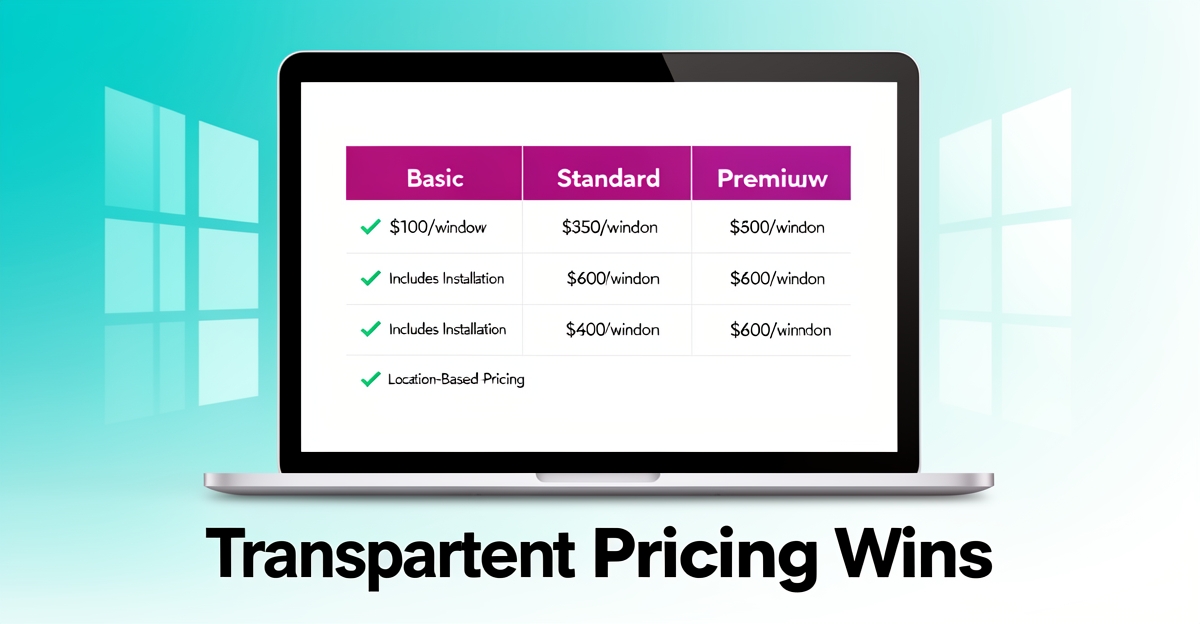
Start by publishing transparent tiered pricing ranges for every product category. Industry benchmarks show basic residential blinds start at $100–$200 per window installed, while premium models with motorization climb to $400–$600 (VelaBlinds pricing guide). Display these tiers side by side with clear labels: “Residential Basic,” “Residential Premium,” “Commercial Standard,” and “Commercial Premium.” This lets prospects self-qualify before they ever pick up the phone, eliminating the 300% quote variance that drives customer confusion (VelaBlinds expert observation).
Next, break down the cost structure so buyers understand exactly where their money goes. Materials account for 60–70% of the total, installation 20–30%, and motorization or smart features add 10–20% more (VelaBlinds cost breakdown). Create a simple pie chart or bullet list showing:
- Materials: $60–$210 per window
- Professional installation: $50–$100 per window (higher for complex jobs)
- Motorization add-on: $300–$500 for basic, $400–$600 for smart models
- Volume discounts: 15–25% off for 10+ windows
Adjust prices automatically for location using AI-generated content. Urban markets typically run 20–30% higher than rural zones due to labor and transportation costs (VelaBlinds regional analysis). Your AI content engine can generate location-specific service pages that update base tiers—no manual work required. Display pricing as “Starting at $X in [City Metro] / $Y in [Surrounding Areas]” with a disclaimer that final quotes require on-site measurement.
Frame pricing in total cost of ownership terms to justify premium options. Custom treatments cost $17–$35 annually versus $16–$30 for ready-made options over their lifespans, but custom offers better energy efficiency and durability (AAA Blind & Shutter Factory annualized cost comparison). Add a “Long-Term Value Calculator” that compares 10-year costs, including replacement cycles and energy savings of 20–30% with premium treatments (AAA energy efficiency claims).
Finally, convert transparency into consultation bookings with a clear next step. Offer a free in-home consultation to provide “accurate measurements and tailored cost estimates,” eliminating guesswork and building trust (AAA consultation promise). End every pricing page with a prominent CTA: “Get Your Exact Quote” followed by the consultation timeline—typically 5–12 days for delivery and one-day installation—so prospects know exactly what to expect when they click.
Local business: doing this the old way?
One system replaces the whole pile.
All of it — the website, the follow-up, the content, the leads — built and run for you for $1,497 + $497/mo. Month-to-month, and you own everything.
See what your build includesAI-Powered Pricing Pages That Update Themselves (No Spreadsheets or Manual Work)
Most window treatment websites force customers to chase quotes that vary by 300% for the same product—only to discover the real cost after a sales call. When prospects can’t self-qualify, they leave. An AI-powered pricing page built into your website fixes this by turning opaque numbers into clear, location-specific tiers that update automatically, so visitors see the right price the first time.
Research shows that regional pricing varies by 20–30% between urban and rural markets due to labor and transportation costs, yet most blinds businesses publish one static price list that ignores these differences. According to industry pricing guides, a window blind project in a city might run $240–$480 installed, while the same setup in a rural area could be $200–$400. Without this granularity, customers either overestimate what they can afford or underestimate what they’ll need—both paths end in abandonment.
The same AI that powers your website’s content can automatically populate location-specific pricing tiers by pulling your local market data. Every page your business serves—from service pages to location listings—can display the right price range based on the visitor’s ZIP code, not a one-size-fits-all estimate. That means:
- Urban markets: 20–30% higher due to labor and shipping costs
- Rural markets: 10–15% lower with adjusted installation timelines
- Tiered pricing (Basic/Residential, Premium/Commercial) adjusted in real time
- Installation and motorization add-ons priced transparently per window
- Seasonal adjustments built in to reflect spring/summer peak demand
Beyond location, the AI can frame pricing in total cost of ownership terms, comparing custom treatments at $17–$35 per year over 10–15 years against ready-made options at $16–$30 per year over 2–5 years. According to window treatment manufacturers, this annualized view reveals that premium custom solutions are cost-competitive long-term while delivering better energy efficiency and durability. The AI can update these comparisons automatically as local material costs fluctuate, ensuring your pricing pages stay accurate without a spreadsheet in sight.
When your pricing page updates itself—tying location, product tier, and seasonality together—prospects stop guessing and start booking. No manual work, no stale data, no lost leads to opaque pricing.
From Price Confusion to 30% More Leads: A 30-Day Rollout Plan
Most blinds businesses know they need pricing on their website — they just don't know where to start. The good news: you can go from zero transparency to a converting pricing engine in 30 days without hiring an agency or learning code.
Week 1: Audit and Structure
Map every product category you sell against the pricing tiers VelaBlinds uses: Residential Basic ($100–200/window installed), Residential Premium ($200–400), Commercial Standard ($150–300), and Commercial Premium ($300–600). Add motorization as separate line items ($300–500 basic, $400–600 smart, $500–800 commercial). Document your actual cost breakdown — materials typically run 60–70% of total project cost, installation 20–30%, with motorization adding a 10–20% premium.
Week 2: Publish Location-Specific Pages
Urban markets cost 20–30% more than rural areas due to labor and transportation differences. Use AI-generated content to create service-area pages that automatically adjust base tiers for each city or neighborhood you serve. Each page should show a "Starting at $X in [Metro] / $Y in [Surrounding Areas]" range with a clear disclaimer that final quotes require on-site measurement.
Week 3: Add Value Framing and CTAs
Frame pricing in total cost of ownership terms. AAA Blind & Shutter Factory shows custom treatments at $17–35/year over 10–15 years versus ready-made at $16–30/year over 2–5 years — making premium options cost-competitive annually. Pair this with energy ROI data: 20–30% reduction in energy loss and up to R-4 insulation values. End every pricing section with a prominent "Get Your Exact Quote" CTA booking a free consultation, noting the typical 5–12 day delivery and one-day install timeline.
Week 4: Test, Measure, Iterate
Swap CTA copy weekly ("Free In-Home Consultation" vs. "See Exact Pricing for Your Windows" vs. "Book Your Measurement") and track which drives more form submissions. Monitor time-on-page for pricing sections — prospects who stay longer than 90 seconds are 3x more likely to convert. Use the built-in analytics to see which location pages generate the most consultation requests, then double down on those areas with deeper content.
- Week 1: Audit products against four-tier pricing structure
- Week 2: Deploy location-adjusted pricing pages
- Week 3: Add TCO framing and consultation CTAs
- Week 4: A/B test CTAs and optimize top performers
AI Business Sites handles the heavy lifting — the platform generates location-specific pricing pages, builds internal linking automatically, and tracks conversion data in one dashboard so you can see what's working without stitching together five tools.
Frequently Asked Questions
Why do blinds companies hide their pricing on their websites?
What’s the best way to show pricing on a blinds website?
Doesn’t showing prices scare away customers who want custom quotes?
How do I adjust pricing for my local market?
What if my prices vary a lot based on the project?
Should I show total cost of ownership on pricing pages?
Stop Losing Leads to Hidden Pricing—Turn Your Website into a 24/7 Sales Machine Today
If your blinds business is still hiding prices behind a vague 'Call for a quote' button, you're not just losing leads—you're losing them to competitors who are already converting prospects before they ever pick up the phone. The research is clear: quotes for identical products can vary by 300%, leaving buyers confused and distrustful of what they'll hear on the call. But businesses like VelaBlinds and AAA Blind & Shutter Factory are gaining an edge by publishing transparent pricing tiers that let prospects self-qualify before making contact. The solution isn't just slapping a few price ranges on your site—it's a complete pricing clarity system that includes location-specific adjustments, cost breakdowns, value framing, and clear next steps. AI Business Sites builds websites that automate this entire process, generating pricing pages tailored to each visitor's region that update in real time. Imagine a prospect in Chicago seeing adjusted tiers that reflect your local costs, then understanding why premium custom treatments are actually more cost-effective over 10 years than cheap ready-made options. That's not just transparency—that's a conversion engine. The best part? You can implement this clarity in under a week without hiring a designer or copywriter. Start with a dedicated pricing page, break down what drives your costs, adjust for location automatically, and end every section with a clear consultation CTA. Your website should work for you 24/7—answering questions, qualifying leads, and booking appointments while you focus on the work that matters.
FOR local businesss — BUILT AND RUN BY US
Your website. Your content. Your leads. Your data.
$500 starts your build. Seven days later it's live — chat, booking, follow-up, and your Google presence all set up. Then we run it, every month. You do the work you actually get paid for.