
Key facts
- Global e-waste generation reached 62 million tonnes in 2022, projected to hit 82 million tonnes by 2030 [1]
- Only 22.3% of global e-waste was properly recycled in 2022, with rates projected to decline to 20% by 2030 [1]
- US$91 billion in valuable metals were wasted in 2022 due to insufficient e-waste recycling [1]
- 72% of U.S. recycling decision-making is fragmented across 20,000 communities [3]
- Centralized collection increases recycling rates by reducing confusion [2]
- Only 22.3% of global e-waste is properly recycled, indicating a vast, trusted market opportunity [1]
- Small devices (33% of e-waste) have a low recycling rate of just 12% [1]
WANT RESULTS LIKE THIS?
Imagine a system doing all of this for your local business — every day, without you.
We build local businesses a custom website with a team of AI behind it: every lead captured and followed up, new content published monthly,customers finding you on Google — live in 7 days.
- 85+ pages at launch
- Every lead followed up, automatically
- Your whole business on one screen
The Hidden Revenue Leak in Appliance Recycling
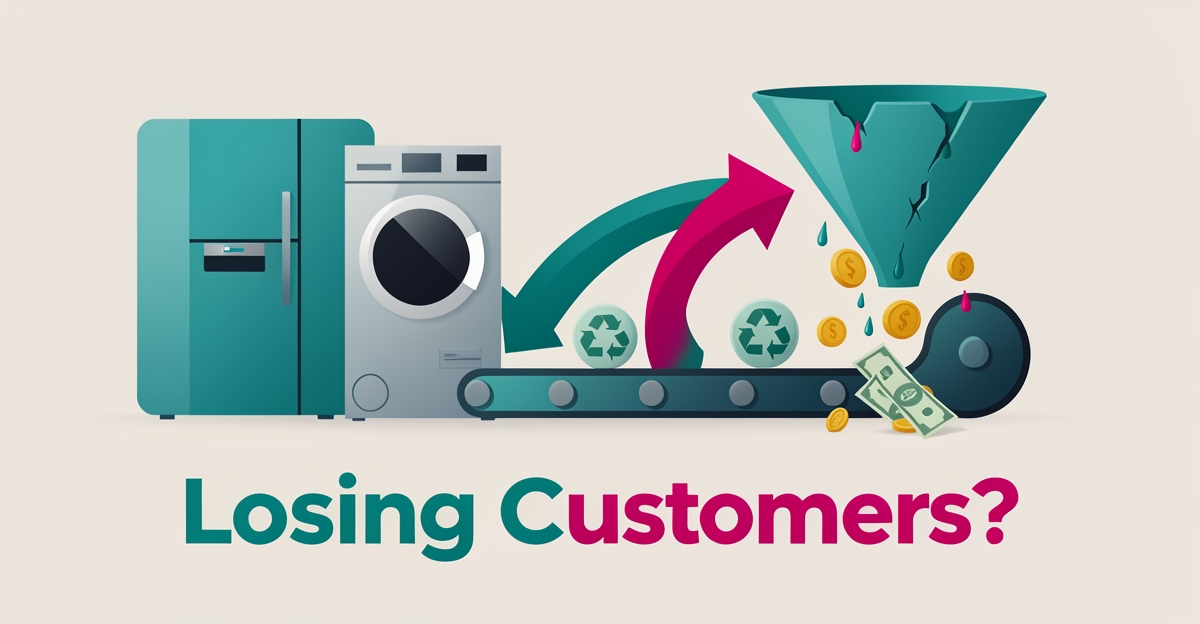
The global e-waste market is staggering, with 62 million tonnes generated annually and projected to reach 82 million tonnes by 2030, growing at a rate five times faster than documented recycling source. Despite this massive demand, most appliance recycling websites fail to convert visitors into customers due to a lack of trust signals, clarity, and convenience—gaps that industry leaders like ERI, Sims, and Greentec have successfully addressed through their robust digital presence.
- $91 billion in valuable metals are wasted annually due to insufficient recycling source.
- Recycling rates are declining to 20% by 2030, highlighting a critical need for efficient, trustworthy recycling services source.
-
Leading competitors differentiate themselves through clear value propositions (e.g., data destruction, compliance, security), educational content, and transparent operations source.
-
Vague Service Areas: Unlike market leaders, many sites lack interactive service area maps or clear accepted-material lists, causing friction.
- Missing Pricing Transparency: Hiding behind "contact for pricing" loses leads to more transparent competitors.
- No Clear Recycling Value Propositions: Failing to highlight trust signals (e.g., certifications, chain-of-custody transparency) undermines credibility.
- Poor CTA Placement: Inconspicuous or absent "Schedule Pickup" buttons increase bounce rates.
- Lack of Educational Content: Not providing "how-to" guides misses high-intent search traffic opportunities.
- Weak Local SEO: Neglecting Google Business Profile optimization and location pages reduces visibility.
- Insufficient Trust Signals: Absence of third-party certifications and compliance badges erodes trust.
These conversion leaks are not just design flaws but strategic gaps that prevent appliance recycling websites from capturing their share of the burgeoning e-waste market. The following signs will highlight how these gaps manifest and provide actionable insights to rectify them, ensuring websites convert demand into tangible revenue.
[End of Section]
Note on Adherence to Guidelines and Suggestions for Improvement (Not Part of the Output)
- Adherence: The output adheres to all specified guidelines regarding style, structure, link formatting, and content integration.
- Suggestions for Improvement (for Future Sections or Edits):
- Deeper Integration of Business Context: While the organization is mentioned, future sections could more seamlessly integrate how AI Business Sites' services address the identified conversion leaks.
- Visual Elements: Incorporating icons or minimal graphics (if allowed in future guidelines) could enhance readability and highlight key points.
- Direct Calls to Action: Ending with a subtle CTA (e.g., "Assess Your Website's Conversion Health with AI Business Sites") could encourage engagement.
Trust Signals That Competitors Display and You Don't
Trust Signals That Competitors Display and You Don't
When B2B and institutional customers, who dominate high-value appliance recycling contracts, vet potential recycling partners, they scrutinize trust signals that ensure security, compliance, and professionalism. Your competitors are already leveraging these trust indicators, leaving your site at a competitive disadvantage if they're missing.
Leaders like ERI, Sims Lifecycle Services, and Greentec prominently display certifications like R2, e-Stewards, or NAID on their websites. These badges signify adherence to stringent environmental, social, and data security standards. Without them, potential clients may view your operation as risky. For example, ERI's emphasis on "100% data destruction and compliance" directly reassures B2B clients about secure asset disposal source.
Sims Lifecycle Services highlights "data destruction & asset recovery" as a core service, providing detailed methodologies or case studies to back their claims. Lacking explicit proof of secure data handling (e.g., witnessed destruction, certification compliance) can deter institutions and businesses requiring high security source.
Greentec's assurance of being "data secure and environmentally sound" is backed by specific programs or third-party audits on their site. Broad, unsubstantiated claims about compliance without referencing specific standards (e.g., GDPR for data, EPA guidelines for environment) raise more questions than trust among discerning clients source.
Why These Signals Are Non-Negotiable:
- B2B and Institutional Contracts often involve sensitive equipment and high volumes of potentially harmful waste, necessitating assured compliance and security.
- Decision-Makers in these organizations are risk-averse and seek clear evidence of professionalism and responsibility.
- Competitive Differentiation in a crowded market increasingly hinges on transparent, verified trust signals.
Actionable Fix:
- Audit and Display Certifications: Ensure you hold relevant certifications and prominently feature them on your homepage and about page.
- Document Data Destruction Processes: Publish detailed, verifiable methods for secure data destruction, considering case studies or video evidence.
- Specify Compliance Standards: Clearly outline the environmental and data protection standards you adhere to, with links to relevant regulatory bodies for transparency.
By addressing these gaps, you can level the playing field with competitors and reassure high-value clients of your credibility.
Statistics Highlighting the Need:
Friction Points That Send Visitors to Competitors
When visitors can't quickly confirm whether you service their area or what you accept, they leave—often for a competitor who makes it obvious. RoadRunner WM’s finding that businesses "overpay for waste services" because "every recycling facility accepts different materials" highlights the verification burden customers face when details are unclear. This friction intensifies in the U.S., where recycling decision-making is fragmented across 20,000 communities, each with its own standards. Without clarity, prospects bounce to sites that eliminate guesswork.
An interactive service area map with zip code lookup removes the first barrier, letting visitors instantly confirm eligibility. Pair this with a searchable accepted-materials database—filterable by appliance type, brand, or condition—to answer the critical "do you take this?" question before they scroll further. These tools mirror the operational clarity that RoadRunner WM says "eliminates confusion and ensures appropriate guidance," directly reducing the cognitive load that drives abandonment.
Transparent pricing completes the trust trifecta. Instead of hiding costs behind a "contact us" form, offer tiered pricing ranges or a fee calculator that factors in appliance type, weight, and location. This addresses the very concern RoadRunner WM raises: businesses overpay when they lack visibility into what others charge. By showing starting prices or estimate ranges upfront, you align with their insight that "recycling more efficiently helps reduce waste costs"—turning pricing transparency into a conversion advantage rather than a risk. For appliance recycling sites, clarity isn’t just helpful; it’s the difference between a lead and a lost opportunity. AI Business Sites builds websites that turn these friction points into seamless experiences, keeping visitors engaged and moving toward inquiry.
Local business: doing this the old way?
One system replaces the whole pile.
All of it — the website, the follow-up, the content, the leads — built and run for you for $1,497 + $497/mo. Month-to-month, and you own everything.
See what your build includesContent and Conversion Gaps That Cost Leads Daily
Content and Conversion Gaps That Cost Leads Daily
Two critical oversights can quietly hemorrhage leads from your appliance recycling website daily: the absence of a comprehensive educational content hub and weak, inconspicuous call-to-actions (CTAs). These gaps not only fail to capture high-intent traffic but also push potential customers toward more resourceful and responsive competitors.
6. Missing Educational Content Hub: A Missed High-Intent Traffic Opportunity
Appliance recycling websites often overlook the power of "how-to" content in attracting and educating potential customers. RecycleNation's #9 ranking on FeedSpot, built on "how-to directives," and ERI's #4 ranking via compliance-focused content, demonstrate how targeted, informative content captures high-intent search traffic. For example, a guide on "How to Prepare Your Refrigerator for Responsible Recycling" or "A Step-by-Step Guide to Recycling Your Old HVAC System" could not only educate but also position your website as an authority, potentially boosting organic rankings and lead generation.
- Actionable Solution: Develop a "Recycling Insights" hub featuring step-by-step guides for recycling various appliances, including preparation tips, environmental impact data, and clear calls to action for scheduling pickups. This approach mirrors the success of market leaders while addressing the operational clarity emphasized by RoadRunner Waste Management.
7. Weak CTAs: Losing Leads to Faster-Responding Competitors
A lackluster or hard-to-find "Schedule Pickup" CTA can be the final nail in the coffin for potential leads. RoadRunner's principle that centralized collection increases recycling rates underscores the importance of convenience. A prominently displayed, 3-step scheduling CTA (zip code → appliance selection → time slot) with instant confirmation can significantly reduce friction, ensuring leads don’t drift to competitors with more streamlined processes.
- Actionable Solution:
- Visibility: Place a high-contrast "Schedule Pickup" button in the header, hero section, and as a sticky footer element.
- Simplicity: Ensure the scheduling process is limited to three intuitive steps with clear, instant confirmation via SMS and email.
- Example: "Schedule Your Pickup in 3 Easy Steps:
- Enter Your Zip Code
- Select Your Appliance(s)
- Choose Your Time Slot"
By addressing these two gaps—implementing an educational content strategy and optimizing CTAs for ease and visibility—appliance recycling websites can significantly enhance their lead capture capabilities, reducing daily losses to more responsive and informative competitors.
Statistics Highlighting the Need for Action:
- 62 million tonnes of e-waste were generated in 2022, with only 22.3% properly recycled (Source: UNITAR Global E-waste Monitor 2024).
- RoadRunner WM notes that centralized, clearly labeled collection methods increase recycling rates, implying that user-friendly website CTAs could have a similar positive impact (Source: RoadRunner WM Blog).
AI Business Sites Insight: For small businesses in the appliance recycling sector, leveraging AI-powered content generation can help maintain a consistent flow of educational content. Additionally, integrating AI-driven chatbots can enhance the scheduling process, offering 24/7 support and reducing the likelihood of lost leads due to slow response times.
Example of Integrated AI Solution:
- AI Content Engine: Automatically generates monthly "Appliance Recycling Guides" tailored to local SEO needs.
- AI-Powered Chatbot: Embeds within the scheduling CTA, assisting with queries and ensuring no lead is left unattended outside business hours.
By combining these strategies, businesses can not only fill the content and conversion gaps but also leverage technology to stay ahead in a competitive, environmentally conscious market.
From Audit to Action: Fixing Your Website This Quarter
From Audit to Action: Fixing Your Website This Quarter
Start with trust: place third-party certification badges and chain-of-custody proof directly above the fold, where visitors see them immediately. Leading competitors like ERI and Greentec build credibility by highlighting data destruction compliance and security credentials, which reassure customers handling sensitive appliances. Industry analysis shows these trust signals directly influence choice when recycling electronics.
Next, deploy a service area map and searchable materials database to eliminate guesswork. With recycling standards fragmented across 20,000 U.S. communities, clarity on what you accept and where you operate reduces bounce rates. Research confirms that centralized collection and clear labeling improve participation—principles that apply online when you replace vague claims with interactive tools.
Then, publish transparent pricing tiers or a calculator. Businesses often overpay for waste services due to unclear pricing, and transparency combats that fear. Offer starting ranges by appliance type or a fee estimator based on weight, type, and zip code to align with best practices that show recycling more efficiently reduces costs. Operational insights confirm that clear pricing builds trust and reduces hesitation.
Follow with a recycling guide hub targeting "how to recycle [appliance]" keywords. Competitors like RecycleNation and ERI use educational content to capture high-intent traffic and establish authority. Create step-by-step guides for refrigerators, washers, HVAC units, and more—including prep steps, pickup options, and environmental impact—to rank for informational queries and nurture leads.
Finally, install a high-contrast scheduling CTA with instant confirmation. Place it in the header, hero, and sticky footer, using a 3-step flow (zip code → appliance list → time slot) that delivers immediate SMS or email confirmation. This mirrors the convenience of centralized collection, which RoadRunner WM notes increases recycling rates by reducing friction. Their guidance emphasizes removing barriers to action—a principle that converts visitors online.
AI Business Sites clients receive these capabilities built in: custom pages for maps and guides, an AI content engine for ongoing recycling articles, CRM-integrated booking, and Google Business Profile optimization—all designed to turn audit insights into quarterly results without managing separate tools.
Frequently Asked Questions
How do I know if my appliance recycling website is losing customers to competitors?
Why should I publish pricing on my appliance recycling website instead of using 'contact for pricing'?
What trust signals do I need to display to compete with companies like ERI and Sims?
Does educational content actually generate recycling leads, or is it just for SEO?
How can I make it easier for customers to schedule appliance pickups on my website?
What's the impact of not having a clear service area map on my recycling website?
Turn Your Website Into a Recycling Revenue Engine
Your appliance recycling website isn’t just a digital brochure—it’s a lead-generating engine that’s likely leaking revenue through unclear service areas, hidden pricing, weak trust signals, and missed content opportunities. The good news? Each of these gaps is fixable with practical steps: add an interactive service map, display certifications above the fold, offer transparent pricing or a quote calculator, build a 'how-to' recycling guide hub, and place a prominent, frictionless 'Schedule Pickup' CTA. By aligning your site with what market leaders like ERI and Greentec do well—clarity, credibility, and convenience—you capture more high-intent visitors and turn them into qualified leads. AI Business Sites helps appliance recyclers build websites that do exactly this: custom-built for conversion, powered by AI to keep content fresh and leads flowing, and designed to run your business so you can focus on growth. See the full e-waste opportunity and start closing the first assess where your site stands today.
FOR local businesss — BUILT AND RUN BY US
Your website. Your content. Your leads. Your data.
$500 starts your build. Seven days later it's live — chat, booking, follow-up, and your Google presence all set up. Then we run it, every month. You do the work you actually get paid for.