
Key facts
- Thrift store foot traffic has surged 39.5% since 2019, far outpacing the broader apparel industry’s 9.5% growth according to Placer.ai.
- Stores using AI pricing report a 400% ROI and save $20,000+ annually while cutting listing time from 2 minutes to 10 seconds per GetCircular.ai.
- Gen Z and millennials now prefer secondhand shopping first, with 62% choosing resale before new purchases reported by the U.S. Census Bureau.
- The global secondhand apparel market is projected to reach $350 billion by 2028, representing 10% of the global apparel market according to Data Catalyst.
- AI pricing eliminates the $45 vs $75 guessing game on every vintage item, ensuring rare finds fund your week instead of collecting dust as documented by GetCircular.ai.
- Thrift stores peak in Q3 (summer) due to back-to-school and warm-weather shopping, unlike conventional retail’s Q4 holiday rush reported by Placer.ai.
- AI Business Sites consolidates 8–10 separate subscriptions into one system that handles leads, pricing, content, and follow-ups automatically while you focus on serving your community per osforyour.business.
WANT RESULTS LIKE THIS?
Imagine a system doing all of this for your local business — every day, without you.
We build local businesses a custom website with a team of AI behind it: every lead captured and followed up, new content published monthly,customers finding you on Google — live in 7 days.
- 85+ pages at launch
- Every lead followed up, automatically
- Your whole business on one screen
Your Website Is Losing Customers While You Sleep
Your website isn’t just a digital storefront—it’s a 24/7 salesperson, inventory manager, and customer service rep all rolled into one. When that system fails to respond in real time, it doesn’t just cost you a sale today; it erodes trust for tomorrow’s shoppers. Research shows thrift store visits have surged 39.5% since 2019—far outpacing the broader apparel industry’s 9.5% growth—leaving no room for delays in customer engagement. Thrift stores can’t afford to let messages sit unanswered, calls go to voicemail, or inventory updates lag behind reality. A slow response time isn’t just an inconvenience; it’s a missed opportunity to convert a browser into a buyer, especially when 62% of Gen Z and millennials prefer secondhand first.
Missed messages and slow replies create a silent exodus. Every unanswered email, ignored chat, or delayed callback sends a clear signal: your store isn’t ready for them. In a market where $350 billion in secondhand apparel sales are projected globally by 2028, hesitation isn’t just bad manners—it’s bad business. Customers don’t just want answers; they want them now. Automated systems like AI Business Sites’ unified inbox ensure no lead slips through the cracks by funneling every interaction—web chat, phone call, form fill, or booking—into a single system with instant, personalized responses. Behind the scenes, the platform tags leads automatically, routes high-priority messages to the right team member, and even drafts replies using your store’s own tone and knowledge base.
The cost of inaction isn’t theoretical. A thrift store operating without these systems risks:
- Losing leads to competitors who respond instantly with tailored messages and real-time inventory updates
- Draining staff time on repetitive tasks like answering the same FAQs or manually tracking restocks
- Undermining SEO momentum built from local search growth by failing to engage visitors after they click
- Missing seasonal peaks—thrift stores see their strongest foot traffic in Q3 (summer)—when delayed responses can turn a hot lead cold
- Overlooking Gen Z’s preference for seamless digital experiences, a group driving the secondhand boom
Automation isn’t a luxury; it’s a lifeline. Stores using AI-powered systems report 400% ROI on pricing tools alone, cutting listing time from 2 minutes to 10 seconds while saving $20,000+ annually. But the real win isn’t just efficiency—it’s consistency. A website that answers questions, sends restock alerts, and reminds customers about returning items works while you sleep, ensuring every visitor feels heard, every lead is nurtured, and your inventory stays fresh. In a market evolving faster than ever, the stores that thrive won’t be the ones with the most inventory—they’ll be the ones that respond the fastest.
Outdated Inventory Pages Are Driving Buyers Away
Outdated inventory pages are a silent conversion killer for thrift stores, especially during peak seasons. Static listings fail to reflect real-time availability, leaving shoppers frustrated when they click on an item only to find it’s long gone. This disconnect is particularly damaging in Q3, when thrift stores see their highest foot traffic due to warm-weather wardrobe refreshes and back-to-school shopping—a seasonal surge conventional retail doesn’t match. Gen Z shoppers, who make up 62% of secondhand preferers, expect instant updates and seamless digital experiences, making stale inventory feel unprofessional and unreliable and their expectations, they don’t just lose sales—they erode trust.
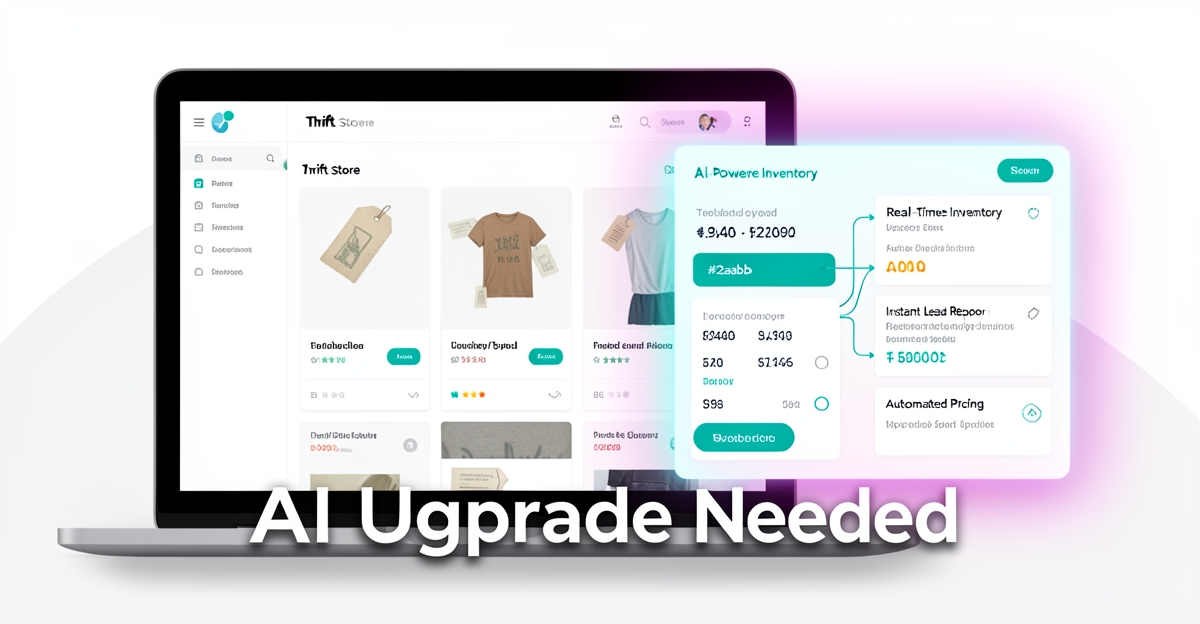
AI-powered automation solves this by syncing inventory changes with customer engagement in real time. When new donations arrive or popular categories are restocked, the system triggers personalized alerts via email or SMS, notifying shoppers exactly when items they’ve shown interest in become available. This proactive approach turns passive browsers into repeat visitors, especially during high-demand periods like late summer. Beyond alerts, AI-generated local SEO content ensures your store appears in searches for “thrift store near me” or “vintage denim [city]” by creating location-specific pages tied to actual inventory trends and community needs.
For thrift stores drowning in manual updates, this integration eliminates guesswork. Instead of relying on staff to refresh listings after every donation drop, the website dynamically reflects what’s on the floor—reducing bounce rates and increasing time-on-site. Platforms like AI Business Sites embed this capability directly into the website’s core, combining real-time inventory tracking with automated follow-ups so no opportunity slips through the cracks. The result is a digital storefront that breathes with your business, keeping pace with both seasonal demand and the expectations of today’s savvy, speed-driven shoppers.
Manual Pricing Is Costing You Thousands in Lost Sales
You know the feeling — staring at a rack of donations, Googling sold listings on eBay, second-guessing whether that vintage denim jacket is worth $45 or $75. Multiply that hesitation by hundreds of items a month, and manual pricing isn't just slow. It's expensive.
Research from Circular shows thrift stores using AI pricing see a 400% ROI and $20,000+ in annual savings while cutting listing time from two minutes to ten seconds per item. That's not incremental improvement — it's a fundamental shift in unit economics.
The problem runs deeper than speed. Inconsistent pricing creates a silent profit drain in two directions. Price too high and inventory stagnates, tying up rack space and cash flow. Price too low and you're leaving margin on the table for every unique piece that walks through your donation door. With the U.S. resale market projected to hit $82 billion by 2026 and thrift foot traffic up 39.5% since 2019, the cost of guessing compounds fast.
AI pricing tools solve this by pulling real-time resale market data — eBay, Poshmark, The RealReal — to suggest accurate prices for unique donations the moment they're processed. As Depop CTO Rafe Colburn notes, these tools "speed up and simplify the [product listing] process, meaning our community can list more, sell more, and earn more." The human still approves. The guesswork disappears.
- Eliminate the $45-vs-$75 paralysis on every unique item
- Prevent overpriced inventory that sits for months
- Stop underpricing rare finds that should fund your whole week
- Scale listing volume without adding staff hours
Platforms like AI Business Sites embed this pricing intelligence directly into the website your store already runs on — no separate dashboard, no integration project, no 3-6 month implementation timeline that specialized operating systems require. The AI assistant that answers customer questions and follows up on leads also helps your team price donations accurately, list them in seconds, and keep inventory moving at the pace today's resale market demands.
Local business: doing this the old way?
One system replaces the whole pile.
All of it — the website, the follow-up, the content, the leads — built and run for you for $1,497 + $497/mo. Month-to-month, and you own everything.
See what your build includesYour Website Is a Digital Cinderella Story
Your thrift store’s website might feel like it’s working hard — but behind the scenes, it’s likely held together by a patchwork of tools that don’t talk to each other. You’ve got one system for email, another for scheduling, a third for tracking donations, and maybe a fourth just to keep your inventory updated. Each subscription adds cost, complexity, and another place where things can fall through the cracks.
This fragmented setup isn’t just inconvenient — it’s expensive and inefficient. Research shows thrift stores using disconnected tools often miss customer messages, display outdated inventory, and struggle to keep up with seasonal demand spikes, especially during Q3 when foot traffic peaks due to warm-weather and back-to-school shopping. Meanwhile, stores that have adopted integrated AI-powered platforms report significant gains, including 400% ROI from automated pricing and over $20,000 in annual savings by eliminating manual bottlenecks.
Instead of juggling eight to ten separate subscriptions — each with its own login, learning curve, and integration headaches — AI Business Sites builds your website to run the business with you. Behind the scenes, a unified platform handles lead follow-up, inventory alerts, customer notifications, and content updates automatically. It’s not about adding more software — it’s about replacing the clutter with one smart system that keeps your thrift store running smoothly, so you can focus on what matters: serving your community and growing your business.
- Thrift store foot traffic has grown 39.5% since 2019, far outpacing the broader clothing industry’s 9.5% increase.
- Stores using AI pricing report 400% ROI and $20,000+ in annual savings while cutting listing time from two minutes to ten seconds.
- The U.S. resale market is projected to reach $82 billion by 2026, driven by Gen Z and millennial shoppers — 62% of whom prefer secondhand before buying new.
You're Still Doing It the Garage-Sale Way
A thrift store running on garage sale energy is like trying to host a roaring bonfire with damp logs. You’re manually lighting matches one by one while the crowd walks away, unaware that the next batch of deals has already arrived. When every listing, email, and customer follow-up happens by hand, growth isn’t just slow—it’s invisible.
Thrift traffic has jumped 39.5% since 2019, yet most stores reply to leads too late to win the sale. According to Placer.ai, the average thrift store visitor expects a response within hours, not days. An AI assistant on your site can answer questions instantly, day or night, using your own knowledge base—turning every chat into a lead before the garage-sale crowd even arrives. Meanwhile, a voice agent can answer calls, book appointments, and capture details while you’re pricing that vintage Levi’s rack.
Behind the scenes, an AI-powered CRM tags leads, moves them through a pipeline, and sends the right follow-up at the right time—with alerts only when your attention is truly needed. Stores using AI pricing report 400% ROI and $20,000+ annual savings, according to GetCircular.ai. That’s the difference between guessing prices in your head and using real-time resale data from eBay and Poshmark to price unique donations accurately.
- Instant auto-responses capture leads from web chat, forms, and phone calls into one system.
- Automated restock alerts notify customers when summer clothes or back-to-school items return.
- AI-generated newsletters go out weekly without you lifting a finger.
- Proactive follow-up sequences replace the “maybe next Saturday” promise.
When your website handles the busywork, you stop burning daylight on garage-sale logistics and start focusing on what actually grows your store.
Turn Your Website Into Your Best Salesperson—While You Sleep
Your thrift store’s website shouldn’t just exist—it should work harder than your best volunteer. The surge in secondhand shopping isn’t slowing down, with thrift traffic up 39.5% since 2019 and Gen Z leading the charge as 62% of them prefer secondhand first. Yet, many stores still lose leads to slow responses, outdated inventory, and manual pricing guesswork, costing time and margin that can’t be recovered. The fix isn’t another tool to manage—it’s building a website that *does the work* for you. By integrating AI-powered responses, real-time inventory updates, and automated follow-ups, your website becomes the silent closer that turns browsers into buyers even when your doors are closed. Stores using these systems report 400% ROI on pricing alone and reclaim thousands in annual savings by eliminating repetitive tasks. The choice isn’t whether to modernize—it’s whether to let competitors capture the customers you’re already attracting. Start by auditing your site’s response times and inventory freshness today, then explore how a unified platform can handle the busywork while you focus on what matters most: growing your business and serving your community.
FOR local businesss — BUILT AND RUN BY US
Your website. Your content. Your leads. Your data.
$500 starts your build. Seven days later it's live — chat, booking, follow-up, and your Google presence all set up. Then we run it, every month. You do the work you actually get paid for.