
Key facts
- 3 days of unplanned downtime costs approximately $2,000 per truck in lost revenue according to fleet management research
- 67% of large commercial fleets use GPS compared to only 40-50% of smaller fleets per industry analysis
- 30.8% of fleets still rely on spreadsheets to track operations due to software workflow gaps
- Electrification and sustainability are increasingly important factors in fleet management decisions and total cost of ownership
- Transparent pricing models with hourly rates and fuel policies are foundational to fleet purchasing decisions per TCO optimization research
- Fleet websites missing equipment type specifications fail procurement teams' primary filter for vendor qualification
- Compliance and safety certifications visible on websites build trust with enterprise clients in regulated industries
WANT RESULTS LIKE THIS?
Imagine a system doing all of this for your local business — every day, without you.
We build local businesses a custom website with a team of AI behind it: every lead captured and followed up, new content published monthly,customers finding you on Google — live in 7 days.
- 85+ pages at launch
- Every lead followed up, automatically
- Your whole business on one screen
The Silent Deal-Killer: Why Vague Service Pages Lose High-Value Contracts
The Silent Deal-Killer: Why Vague Service Pages Lose High-Value Contracts
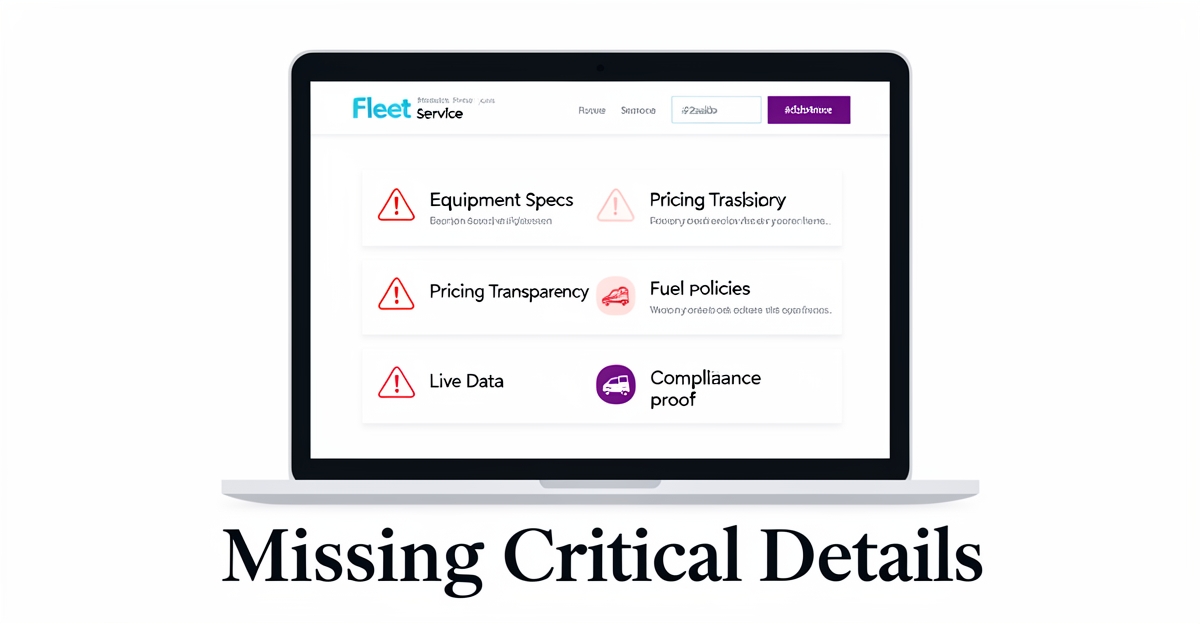
When a fleet manager lands on your website, they're not just browsing — they're vetting. Every missing detail on your service page acts as a silent filter, weeding out serious prospects before they ever pick up the phone. Vague descriptions of equipment types, hourly rates, or fuel policies don't just frustrate visitors; they signal operational opacity, making your business look unprepared for the scrutiny of high-value contracts. In an industry where 3 days of unplanned downtime costs approximately $2,000 per truck in lost revenue, prospects demand transparency upfront — they need to know you can minimize risk, not add to it.
Your website functions as a qualification gate, either passing or failing the 'serious vendor' test in seconds. Research shows 30.8% of fleets still rely on spreadsheets to track operations, a stark indicator that many prospects are actively evaluating whether vendors understand their workflow complexities. If your service pages lack the specificity to reassure these spreadsheet-dependent operations — clear vehicle type support, pricing models, or sustainability capabilities — you're not just losing clicks; you're disqualifying yourself from consideration. Fleet managers seeking partners who can integrate with their existing systems or elevate their operational visibility won't waste time on sites that force them to guess.
Transparency isn't optional — it's the foundation of trust in fleet services. Prospects aren't just buying a service; they're investing in reliability, and your website must prove you deliver it before the first conversation begins. Missing critical details doesn't just create questions — it creates doubt, and doubt kills deals. By contrast, sites that explicitly outline supported vehicle types, pricing structures, and fuel/energy policies align with what serious clients are actively searching for: proof you speak their language and understand their pain points. In a market where GPS adoption disparities reveal varying levels of technological sophistication (67% of large fleets vs. 40-50% of smaller fleets use GPS), your website must meet prospects where they are — offering clarity that builds confidence, not confusion.
AI Business Sites helps local service businesses turn their websites into active qualification tools by auto-generating and updating service details from operational data. This ensures transparency is baked into every page, reducing drop-offs and attracting clients who value precision. When your site answers the tough questions before they're asked, you don't just earn a click — you earn the right to be considered.
Red Flag 1: Missing Equipment Type Specifications That Match Fleet Reality
Red Flag 1: Missing Equipment Type Specifications That Match Fleet Reality
Imagine landing on a fleet management website with a generic "We Service Fleets" banner, only to leave frustrated because there's no clear indication if they support your specific heavy-duty trucks or unique equipment needs. This oversight is more common than you think, and it's a significant turn-off for mixed and heavy equipment operators seeking tailored services.
According to Opsima's findings (fleet management software comparison), one-size-fits-all approaches fail to meet the diverse needs of mixed and heavy equipment fleets. This customization gap directly translates to website content, where listing supported vehicle types, weight classes, and attachment capabilities becomes a primary filter for procurement teams. Without this transparency, potential clients are left guessing, often moving on to more informative competitors.
The Impact at a Glance:
- 67% of large commercial fleets use GPS, compared to only 40-50% of smaller fleets, highlighting the variability in needs (Opsima).
- 30.8% of fleets still rely on spreadsheets due to software not fitting their workflows, indicating a need for more tailored website service descriptions (Opsima).
- Unplanned downtime costs approximately $2,000 per truck over just three days, emphasizing the importance of clear, capable service listings to prevent such losses (Opsima).
Why This Matters for Your Website:
- Trust and Credibility: Explicitly detailing the types of equipment your fleet management service supports establishes immediate credibility with potential clients.
- SEO Advantage: Including specific vehicle types and capabilities can improve your website's visibility for targeted, high-intent search queries.
- Conversion Rates: By clearly matching your services to the visitor's needs upfront, you reduce bounce rates and increase the likelihood of conversion.
Actionable Solution: Ensure your fleet management website clearly outlines:
- Specific Vehicle Types supported (e.g., trucks, cranes, excavators)
- Weight Classes handled
- Attachment Capabilities (if applicable)
This simple yet often overlooked detail can significantly enhance your website's effectiveness in attracting and retaining serious, relevant clients. At AI Business Sites, we understand the importance of tailored online presence and can help you craft a website that speaks directly to your target audience's needs, complete with custom-built pages designed around your actual services and AI-driven content that keeps your site fresh and relevant.
By addressing this red flag, you're not just filling a content gap; you're bridging the operational visibility gap that Opsima and other industry insights highlight as crucial for fleet management success.
Red Flag 2: Hidden Pricing Models and Absent Hourly Rate Transparency
When a fleet manager lands on your site, they're not browsing — they're budgeting. Every minute spent hunting for an hourly rate or deciphering emergency surcharges is a minute they're evaluating competitors who already posted theirs. According to industry analysis, 30.8% of fleets still track operations via spreadsheets because software doesn't fit their workflows — a clear signal that opaque pricing drives decision-makers back to manual workarounds.
Hidden pricing models create immediate friction. Fleet buyers need to model total cost of ownership instantly, comparing contract tiers against on-demand rates before they ever pick up the phone. When hourly rates, fuel policies, and after-hours surcharges live only in a PDF or a sales rep's head, you force prospects to self-disqualify. Research from Autofleet's TCO optimization framework emphasizes that continuous, transparent cost visibility is foundational to fleet purchasing decisions — not a nice-to-have.
- Base hourly rates for each equipment class
- Emergency and after-hours surcharge structure
- Contract vs. on-demand pricing tiers
- Fuel and energy policy details
AI Business Sites builds this transparency directly into service pages, auto-generating and updating pricing details from your service data so fleet buyers can model costs on the spot. The result: fewer "what do you charge?" inquiries, faster qualification, and leads who already know your numbers work for their budget.
Red Flag 3: No Fuel and Energy Policy Details for Modern Fleets
Red Flag 3: No Fuel and Energy Policy Details for Modern Fleets
Today's fleet clients demand transparency about how their vehicles are fueled and charged, yet many websites remain silent on these critical operational details. This omission signals a lack of preparedness for the evolving energy landscape, particularly as fleets navigate mixed-energy operations and rising sustainability expectations. Without clear information on fuel card acceptance, EV charging compatibility, or carbon reporting capabilities, businesses risk losing credibility with environmentally conscious clients and those managing complex energy transitions.
According to industry research, electrification and sustainability are increasingly important factors in fleet management decisions, directly influencing total cost of ownership and client selection. A recent analysis further notes that 30.8% of fleets still rely on spreadsheets to track operations, highlighting a widespread gap in digital operational visibility that extends to energy policy communication. When websites fail to address fuel and energy specifics, they inadvertently reinforce this visibility gap, making it difficult for clients to assess compatibility with their own sustainability goals or mixed-fleet requirements.
- Clearly state accepted fuel cards and payment systems for traditional fleets
- Detail EV charging infrastructure partnerships and accessibility
- Outline sustainability reporting capabilities and carbon metrics tracking
- Specify policies for hybrid, electric, and alternative fuel vehicles
- Explain how energy data integrates with service billing and client reporting
For businesses using AI Business Sites, this level of detail can be automatically generated and kept current through the platform’s content engine, which pulls from real service data to ensure transparency. By proactively sharing fuel and energy policies, fleet operators demonstrate operational flexibility and build trust with clients who prioritize both efficiency and environmental responsibility in their vendor selection.
Local business: doing this the old way?
One system replaces the whole pile.
All of it — the website, the follow-up, the content, the leads — built and run for you for $1,497 + $497/mo. Month-to-month, and you own everything.
See what your build includesRed Flag 4: Disconnected Operational Data That Creates Visibility Gaps
Fleet buyers don't have time to chase down basic operational details that should be front and center. When a website shows static service pages while the shop floor runs on live data — technician certifications, bay capacity, parts inventory — prospects are forced into manual verification mode. That friction kills deals. Research shows generic fleet management software often fails to capture critical off-system operational data like radio calls and shift handovers, leaving a visibility gap that static websites simply mirror.
The cost of that disconnect is measurable. Three days of unplanned downtime costs approximately $2,000 per truck in lost revenue, and buyers know it. They're not browsing for brochures — they're evaluating whether a partner can deliver uptime guarantees backed by real-time visibility. Yet 30.8% of fleets still track operations via spreadsheets because their software doesn't fit their workflow, a stat that signals how many service providers are stuck in the same manual rut.
Serious buyers expect a technology-forward partner to surface live operational data, not hide it behind a contact form. That means showing current shop capacity, certified technician availability, and parts readiness — not just a list of services offered. When that data lives in disconnected systems, the website becomes a liability instead of a lead generator.
- Real-time bay and technician capacity
- Live parts inventory for common repairs
- Current certification status for specialized work
- Dynamic scheduling windows based on actual workload
- Instant quote accuracy tied to live labor rates
AI Business Sites builds websites that pull from the same operational data your team uses daily, so prospects see live availability, not marketing copy. The platform auto-generates and updates service details based on actual shop data, ensuring transparency and reducing the back-and-forth that drives buyers to competitors who can answer "when can you fit me in?" with a real-time answer.
Red Flag 5: Missing Proof of Compliance, Safety, and Audit Readiness
Red Flag 5: Missing Proof of Compliance, Safety, and Audit Readiness
Imagine landing on a fleet management website, only to find a glaring omission: no visible proof of DOT compliance, safety ratings, or audit trails. For enterprises in regulated industries, this isn't just an oversight—it's a disqualifier. According to industry experts, transparency in compliance and safety is paramount for building trust with potential clients.
The Trust Gap
Fleets operating in regulated spaces must navigate stringent safety and compliance standards. A website lacking clear evidence of these credentials—such as current DOT certifications or safety audit results—raises immediate red flags. Research highlights that 30.8% of fleets still rely on spreadsheets, indicating a broader issue with operational transparency that websites must counteract by being forthcoming about their regulatory adherence.
Closing the Credibility Gap
Publishing certifications and inspection protocols on the website instantly bridges this gap:
- Clear Compliance Section: Dedicated page for all relevant certifications and compliance documents.
- Safety Record Transparency: Regularly updated safety metrics and audit results.
- Audit Trail Accessibility: Easy access to historical compliance and safety inspection records.
The Consequence of Silence
In an industry where sustainability and optimization are increasingly valued, silence on compliance and safety equals lost opportunities. Enterprises seeking reliable fleet partners will inevitably bypass websites that fail to provide transparent proof of their regulatory and safety standing, opting instead for those that openly demonstrate their commitment to these critical aspects.
AI Business Sites Insight
For fleet management companies, having a website that not only lists services but also seamlessly integrates proof of compliance, safety records, and audit readiness is crucial. This approach not only meets the unspoken requirements of enterprise clients but also sets the business apart in a competitive market, ensuring the website acts as a trust-building, lead-generating asset rather than a mere online presence.
How to Fix All Five Without Rebuilding Your Website From Scratch
Here is the written section based on the provided specifications and research data:
Imagine having a website that automatically keeps your fleet management service details up-to-date, transparent, and attractive to potential clients without requiring manual upkeep. AI Business Sites achieves this through its innovative platform, which auto-generates and maintains critical service details such as equipment matrices, rate cards, fuel policies, live capacity, and compliance badges directly from your actual service data.
- Equipment Types and Pricing Made Clear: AI Business Sites ensures your website clearly outlines supported vehicle types and transparent pricing models, including hourly rates, directly addressing the operational visibility gap identified in fleet management software source.
- Fuel/Energy Policies and Sustainability: If applicable, your website will prominently feature electrification capabilities and sustainability efforts, aligning with market trends towards reduced Total Cost of Ownership (TCO) source.
- Reduced Unqualified Inquiries: By clearly displaying service details, you attract more relevant leads.
- Faster Close Cycles: Transparent pricing and capabilities speed up the decision-making process for potential clients.
- Operational Insights Integration: Where feasible, real-time operational data enhances trust and differentiates your service source.
AI Business Sites transforms your website into a self-sustaining tool. For instance, if 30.8% of fleets still rely on spreadsheets due to software not fitting their workflows source, your platform fills this gap by integrating tailored, web-visible service details that reflect your fleet's unique capabilities. This approach not only addresses the operational needs of diverse fleets but also speaks to the broader challenge of downtime costs, where just 3 days of unplanned downtime can cost approximately $2,000 per truck source.
By leveraging AI to maintain accuracy and transparency, you enjoy fewer unqualified inquiries, faster close cycles, and the peace of mind that your online presence is always reflecting your best service capabilities without manual intervention.
This solution is particularly beneficial for mixed and heavy equipment fleets often underserved by generic platforms, ensuring your website highlights what sets your service apart in a competitive market.
AI Business Sites builds and maintains this dynamic presence for you, ensuring your fleet management website not only exists online but thrives as a lead-generating, client-trusting asset.
Frequently Asked Questions
Why do fleet managers leave our website without contacting us?
What specific equipment details should our service pages include to win mixed-fleet contracts?
Do we really need to publish hourly rates and surcharges on our website?
How do fuel and energy policies affect whether a fleet chooses us?
What's the cost of having static service pages instead of live operational data?
Is a compliance section really necessary if we're already certified?
Your Website Should Qualify Buyers Before You Do
Vague service pages don't just leave questions unanswered — they disqualify you from high-value contracts before the first conversation starts. Fleet managers evaluating partners need to see supported equipment types, transparent pricing models, fuel and energy policies, live operational capacity, and proof of compliance without digging. When those details are missing, the message is clear: this vendor isn't ready for the scrutiny serious buyers bring. The cost of that silence is measurable — three days of unplanned downtime costs approximately $2,000 per truck — and prospects know it. AI Business Sites builds websites that surface the specifics buyers are searching for, auto-generating and updating service details from your actual operational data so transparency isn't a one-time project, it's a permanent advantage. If your site forces prospects to guess, it's time to stop leaving money on the table. See how a self-maintaining service site changes the conversation — book a quick demo and watch your website start qualifying leads for you.
FOR local businesss — BUILT AND RUN BY US
Your website. Your content. Your leads. Your data.
$500 starts your build. Seven days later it's live — chat, booking, follow-up, and your Google presence all set up. Then we run it, every month. You do the work you actually get paid for.